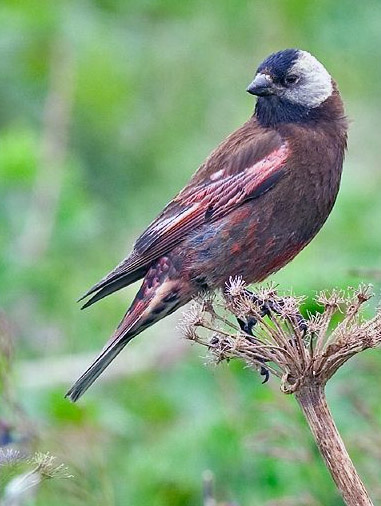
The Gray-crowned Rosy-Finch are found in high-mountain rocky and snowy areas during the summer breeding season, but will occasionally spill out onto the Great Plains during winter as they seek lower elevations. There are different races with variations in the gray nape which gives the bird its name, as well as subtle variations in body plumage. All of the Rosy-Finches, including the Gray-crowned, develop a "pouch" in the upper throat during the breeding season which is capable of holding large quantities of seeds for feeding to their young.
Habitat
During the summer breeding season, they are primarily found on the rocky tundra and snowfields of high mountains. They are generally found in the same type of open habitat during the winter months, although they can also be found in suburban settings at times.
Diet
The Gray-crowned Rosy-Finch feeds primarily on seeds of grasses, weeds, and alpine plants throughout much of the year. During the breeding season, it also consumes insects, spiders, and other small invertebrates, which provide essential protein for adults and nestlings.
Behavior
The Gray-crowned Rosy-Finch is a hardy, social bird that often forages in flocks, especially during winter. It spends much of its time on the ground, searching for seeds and insects among alpine tundra, rocky slopes, and snowfields. During the breeding season, pairs become territorial around nest sites, but the species remains relatively tolerant of neighboring birds and frequently gathers in groups when food is abundant.
Breeding
Non-breeder in South Dakota. The Gray-crowned Rosy-Finch nests in sheltered crevices on cliffs, rocky ledges, talus slopes, and occasionally in abandoned buildings or mine shafts in alpine environments. The female builds a cup-shaped nest of grasses, mosses, rootlets, and feathers, usually well protected from wind and predators. She typically lays 3–5 pale bluish or greenish eggs, and both parents help feed the nestlings after they hatch.
Song
The Gray-crowned Rosy-Finch gives a variety of clear, musical calls, including soft whistles, chirps, and tinkling notes that are especially noticeable in flight. Its song is a pleasant series of warbling, twittering phrases delivered from rocks, cliffs, or during display flights in the breeding season. Flocks also maintain contact with frequent, high-pitched call notes while foraging and flying together.
Migration
Some in Alaska and parts of the Rockies may be permanent residents. However, most of those in Canada and the continental United States move to lower elevations during the winter, and will sometimes move well eastward into the Great Plains. The Gray-crowned Rosy-Finch is primarily an altitudinal migrant, breeding in alpine and subalpine habitats and moving to lower elevations during winter. Many birds descend into valleys, foothills, grasslands, and open agricultural areas after the breeding season, although some populations also make short southward movements. These seasonal shifts are driven largely by snow cover and food availability rather than long-distance migration.
Interactive eBird map
Click here to access an interactive eBird map of Gray-crowned Rosy-Finch sightings
Similar Species
Black Rosy-Finch , Brown-capped Rosy-Finch
Conservation Status
The Gray-crowned Rosy-Finch is classified as Least Concern by the International Union for Conservation of Nature because of its large range and stable overall population. Although some local populations may be affected by climate change, habitat alteration, and changing alpine conditions, the species remains widespread across western North America's mountain ranges and is not currently considered globally threatened.
Further Information
- eBird - Gray-crowned Rosy-Finch
- Audubon Field Guide - Gray-crowned Rosy-Finch
- Cornell Lab of Ornithology - All About Birds: Gray-crowned Rosy-Finch
Photo Information
March 2007 - St. Paul Island, Alaska - Alan D. Wilson - Wikipedia Creative Commons
