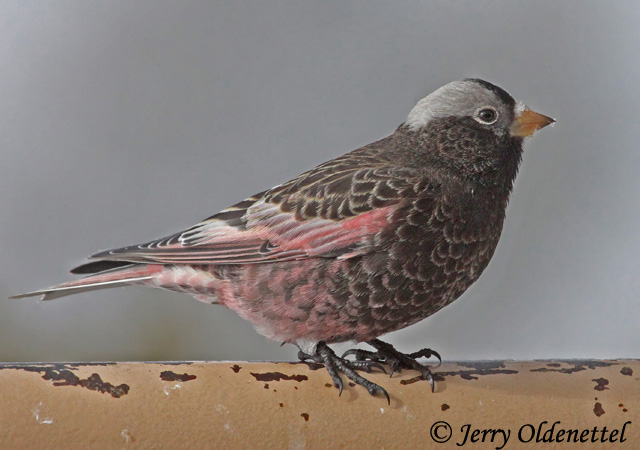
The Black Rosy-Finch is a rather uncommon bird that breeds in high elevation areas of the northern Rocky Mountains in the western United States. They summer in rocky tundra areas above treeline, often in areas near permanent snow and ice. They are most often encountered by people during the winter months, as they move to lower elevations for the winter, and can sometimes be found at feeders in suburban areas. They may hybridize with Brown-capped Rosy-Finch and the Gray-crowned Rosy-Finch where their ranges overlap. All three species are closely related.
Habitat:
Found in barren tundra areas on high elevation areas of the Rocky Mountains, usually in rocky areas with permanent snowfall nearby. During the winter, they will move to lower elevation valleys and plateaus, using a variety of open habitats.
Diet:
Feeds heavily on seeds, especially during the winter months when seeds may make up nearly all of its diet. During the summer months, they also will feed on insects, particularly during the breeding season when young are being raised. They will also sometimes eat other items such as new shoots and buds of plants.
Behavior:
Does most of its foraging by walking along the ground in search of seeds. They will also sometimes feed in low vegetation, or fly up from the ground to capture insects in flight.
Nesting:
The nest of a Black Rosy-Finch is a cup of grasses and moss, built in a crevice on a cliff face or in a crevice between large rocks. The female usually lays 4 or 5 eggs, and she alone incubates them. After the eggs hatch, both parents help to feed the young. The young leave the nest after about 3 weeks.
Interactive eBird Map:
Click to access an interactive map of Black Rosy Finch sightings
Song:
The song of the Black Rosy-Finch is a series of simple, husky whistles that descend during the song. They also have chirps that are often described as less musical than those of other finch species. These vocalizations are most commonly heard during the breeding season on high-alpine cliffs, where the birds use them to maintain contact in their rugged, windy environments.
Migration:
Most birds move to lower elevations in the fall, with some found in winter well south of their breeding range.
Similar Species:
Similar to the Gray-crowned Rosy-Finch and Brown-capped Rosy-Finch .
Feeders:
Will attend feeders for various seeds.
Conservation Status:
The Black Rosy-Finch is currently considered a species of high conservation concern because its specialized high-alpine nesting habitats are exceptionally vulnerable to the effects of climate change. While global populations are currently relatively stable, they remain one of North America’s least-studied birds, leading many organizations to prioritize them for sensitive species monitoring. The IUCN lists the Black Rosy-Finch as a species that is "Endangered".
Photo Information:
Photo taken by Jerry Oldenettel - January 31st, 2010 - Albuquerque, New Mexico - Photo licensed under Creative Commons Attribution NonCommercial ShareAlike 2.0 Generic License .
