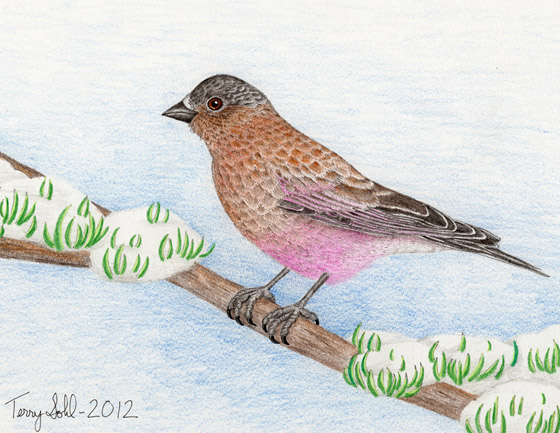
The Brown-capped Rosy-Finch is only found in a very small home range, with most birds found in high-elevation areas of Colorado. Small and local populations can also be found in extreme southern Wyoming, and in northern New Mexico. While Brown-capped Rosy-Finches are the most "southerly" of the Rosy-Finches, the habitats they prefer are still very harsh and inhospitable, typically barren tundra and frozen snowfields at high elevation.
Habitat
Found in barren tundra, rocky slopes, and snowfields above timberline during the summer breeding season. In winter, they can be found in a variety of lower-elevation habitats, and can even be found in suburban settings.
Diet
Seeds are consumed year-round and make up a large part of the diet, especially in winter. The summer diet includes many insects and spiders. Other food items include fresh buds and leaves.
Behavior
Most foraging is done on the ground, with birds picking small insects and from high-elevation snowfields and tundra in the summer, and foraging ont he ground for seeds in the winter.
Nesting
The nest of Brown-capped Rosy-Finches is placed in a well-sheltered locations such as a crevice on a rocky cliff, in a cave or mine shaft, or occasionally in abandoned buildings above timberline. The female constructs the nest, using moss, grass, and other plant material. Both parents help to raise the young.
Song
Song is rarely heard, but is a slow weries of descending whistled notes. The call is a buzzy jeeew .
Migration
Migration of the Brown-capped Rosy-Finch is all altitudinal, with birds moving to lower elevations for the winter. The amount of downslope dispersal seems to be related to the severity of the winter.
Interactive eBird Map
Click to access an interactive map of Brown-capped Rosy-Finch sightings
Feeders
Will occasionally attend feeders for seeds in the winter, when the move from their higher-elevation summer breeding grounds.
Similar Species
Black Rosy-Finch , Gray-crowned Rosy-Finch. To differentiate these high-altitude specialists, focus on the distribution of gray on the head and the primary body color. The Gray-crowned Rosy-Finch is the most widespread and features a distinctive gray patch that starts behind the eye and wraps around the back of the head, contrasting with a brown back and breast. The Black Rosy-Finch is the darkest of the three, sporting a mostly black body that makes its silvery-gray crown patch and pinkish wing highlights pop. The Black-capped Rosy-Finch lacks the extensive gray hood of the Gray-crowned, instead showing a clean black cap on the forehead that transitions into a brownish-pink nape and back
Conservation Status
The IUCN lists the Brown-capped Rosy-Finch as a species that is "Threatened", primarily due to its extremely restricted breeding range in the high-elevation Rockies and its vulnerability to climate change. While a 2023 analysis suggested a larger population than previously estimated (around 115,000–150,000 birds), it remains a Red Alert Tipping Point species because of long-term population declines and the loss of its critical alpine snowfield habitats.
Further Information
- eBird - Brown-capped Rosy-Finch
- Audubon Field Guide - Brown-capped Rosy-Finch
- Cornell Lab of Ornithology - All About Birds: Brown-capped Rosy-Finch
Image Information
Colored pencil Drawing - Terry Sohl - February 2012
