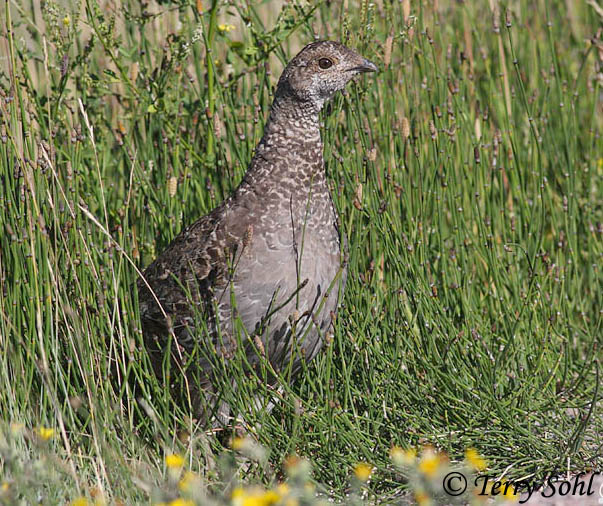
Until recently, the Dusky Grouse and the Sooty Grouse were considered one species, the Blue Grouse. The Dusky and Sooty Grouse are large grouse of mountain forests of the West. The Dusky Grouse is the species found in more interior locations of North America, while the Sooty Grouse is found in areas near the Pacific Coast. Only the 2 Sage Grouse species are larger among North American grouse species. Observations of the species were made in the Black Hills during the 1800s, but the species was probably extirpated from the state by 1900 (Birds of South Dakota -- SDOU, 2001). Reintroduction efforts since that time have evidently been unsuccessful, with no observed birds more than 2 years after any reintroduction attempt.
Habitat
The Dusky Grouse inhabits coniferous forests, mixed mountain woodlands, forest edges, and shrub-covered slopes of western North America. It is especially associated with ponderosa pine, Douglas-fir, spruce, fir, and aspen forests, often moving between open understories and denser woodland cover, in areas with substantial forest edge habitat.Diet
The Dusky Grouse feeds on a wide variety of plant material, including leaves, buds, flowers, berries, seeds, and conifer needles. During summer it also consumes insects such as ants, beetles, grasshoppers, and other invertebrates, which are especially important for protein for raising young. In winter, conifer needles—particularly those of pine, fir, and Douglas-fir—become a major component of the diet.Behavior
Primarily forages on the ground during the summer months, when the diet includes many insects, berries, flowers, and leaves. During the winter months, the diet is dominated by conifer needles, and foraging behavior changes, with birds foraging in evergreen trees.Nesting
The Dusky Grouse nests on the ground in a shallow depression concealed beneath shrubs, grasses, fallen logs, or low tree cover. The nest is lightly lined with leaves, grasses, needles, and other nearby vegetation. Typical clutches contain 5–10 eggs, and the female alone incubates the eggs and cares for the young after hatching.Song
The Dusky Grouse is best known for the male's deep, low-frequency hooting display, often described as a series of soft hooting notes that can carry surprisingly long distances through mountain forests. During courtship, males also perform visual displays involving inflated neck sacs and fanned tails. Additional vocalizations include clucks, cackles, and soft contact calls used by females and broods.Migration
The Dusky Grouse is generally nonmigratory, remaining within mountain regions throughout the year. However, many populations make seasonal elevational movements, occupying higher elevations during the breeding season and moving to lower-elevation conifer forests in winter. In the Black Hills, these movements are local rather than long-distance, and the species is considered a year-round resident.Interactive eBird Map
Click here to access an interactive eBird map of Dusky Grouse sightingsSimilar Species
Sooty Grouse: Dusky Grouse generally occurs farther inland and tends to be paler gray-brown overall, while Sooty Grouse of the Pacific Coast is darker and sootier in appearance. Range is often the most useful clue, as the two species are largely separated geographically.
Spruce Grouse: Spruce Grouse are smaller and more compact, with males showing bold white spotting and a bright red eye comb. Dusky Grouse are larger, longer-tailed, and lack the extensive white spotting typical of Spruce Grouse.
Ruffed Grouse: have a distinctive fan-shaped tail with a broad dark terminal band and prominent neck ruffs, features lacking in Dusky Grouse. Dusky Grouse are larger, longer-necked birds of conifer forests and mountain habitats, whereas Ruffed Grouse are more closely associated with deciduous and mixed woodlands.
