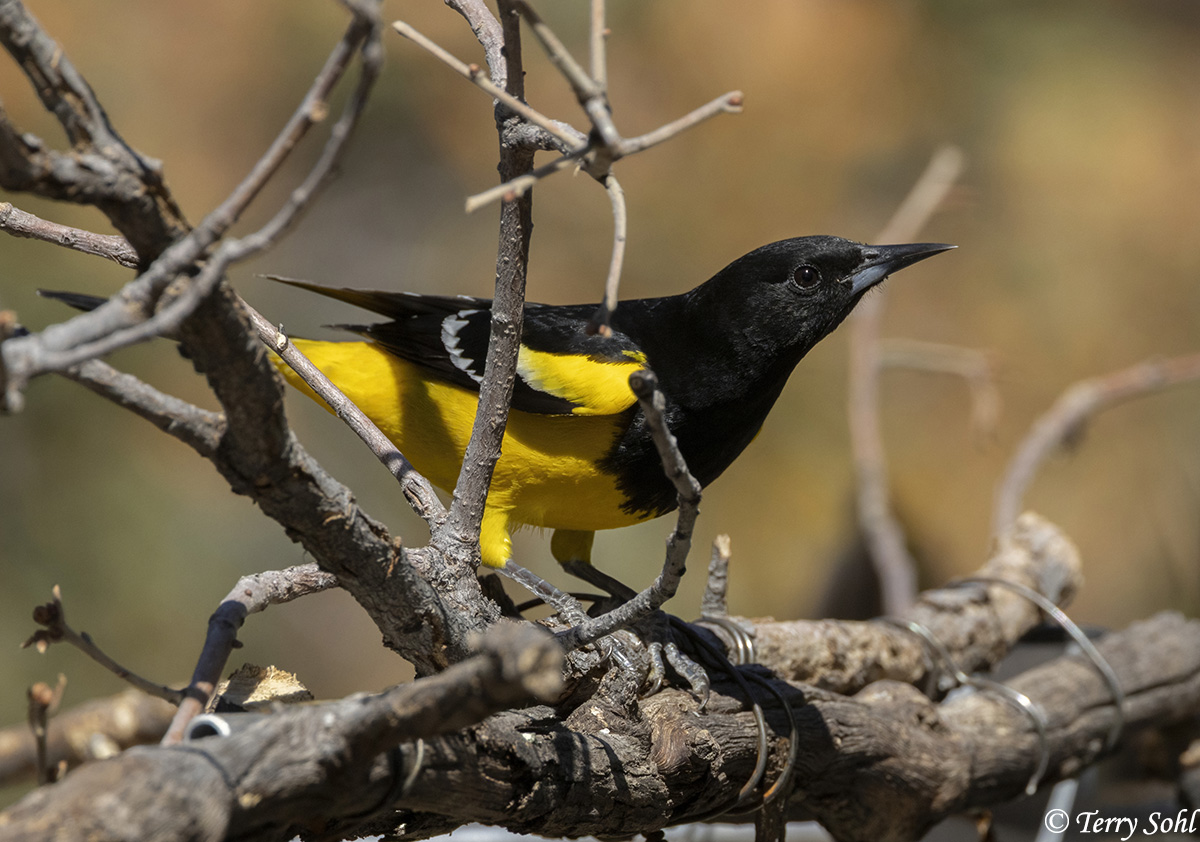
ID Keys: Males black head and breast, black wings with yellow
coverts and white wing-bar, yellow underparts and base of tail
The
Scott's Oriole is an oriole of the American southwest and Mexico, where they
frequently nest in yuccas, but also can be found in a variety of other dry,
semi-open habitats. They are most similar in appearance to Audubon's Oriole,
but the ranges of the two species do not overlap. The yellowish
overall coloring and extensive black on the head, chest, and back separate
the Scott's Oriole from other oriole species found in the same range.
Habitat
Found in a variety of semi-open habitats
in semi-arid areas of the southwestern U.S. and western Mexico. They
can be found in open woodlands of pinyon and juniper, in dry areas with
scattered oases of palms and other trees, along riparian areas, and in
stands of Joshua-trees.
Diet
The Scott's Oriole feeds on insects, spiders, nectar, fruits, and seeds. During the breeding season it relies heavily on insects such as beetles, caterpillars, grasshoppers, and ants, while nectar from agaves, yuccas, and flowering desert plants becomes an important food source, especially in arid habitats.
Behavior
Feeds by deliberately climbing through
vegetation as it searches for insects, usually foraging a low to moderate
heights. They will also sometimes forage on the ground. Scott's
Orioles will also pierce flowers to retrieve nectar, and visit feeders for
nectar and fruit.
Nesting
The nest is a hanging basket woven of
grasses, hair, plant stems, and other thin fibrous plant material. It
is placed in a tree, yucca, or Joshua tree, usually around 5 to 25 feet from
the ground. The female alone incubates the eggs, with an incubation
period of about 2 weeks. Both parents feed and tend to the young after
they hatch.
Song
The Scott's Oriole sings a rich, clear, and highly musical series of whistled phrases. The song is slower, more flute-like, and less hurried than that of many other orioles. Calls include sharp chuck notes, chatters, and harsh scolding sounds used in territorial and alarm situations.
Migration
Some Scott's Orioles in Mexico are
likely permanent residents, but most are strongly migratory. In the
U.S. portion of their range, most migrate to Mexico for the winter, but a
handful may overwinter in southern California and Arizona.
Audubon's Oriole,
Hooded Oriole,
Streak-backed Oriole. The Scott's Oriole is distinguished by its black head, throat, back, and chest combined with a bright yellow belly and shoulder patches. Compared to the Hooded Oriole, Scott's Oriole has a much larger black bib and black back, whereas Hooded Orioles are mostly orange-yellow with only a black throat and face. Audubon's Oriole is mostly yellow with a black hood and lacks the extensive black chest and back of Scott's Oriole. The Streak-backed Oriole is larger, more orange overall, and shows a distinctive black-streaked orange back, a feature not present on Scott's Oriole.
Feeders
Scott's Orioles will visit feeders
for offered fruit, and will visit hummingbird feeders for nectar.
Conservation Status
The Scott's Oriole is generally considered a species of low conservation concern, but populations have shown declines in parts of its range over recent decades. Potential threats include loss and degradation of desert scrub, pinyon-juniper woodlands, and yucca-agave habitats, along with the effects of drought and climate change on desert ecosystems. Despite these concerns, the species remains widespread across much of the southwestern United States and Mexico.
The IUCN lists the Scott's Oriole as a species of "Least Concern".
Photo Information
Photo taken on April 12th, 2023 by Terry Sohl, in Madera Canyon, Arizona.