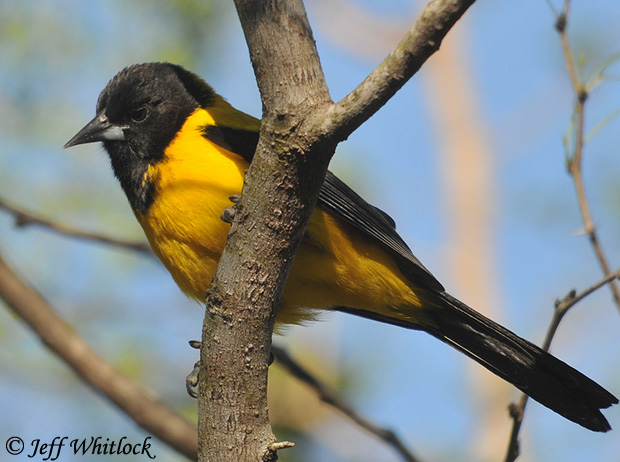
The Audubon's Oriole is primarily a bird of Mexico, with a range that just crosses into the U.S. in far southern Texas. There, they are uncommon and most often found in woodland forests along the Rio Grande river. Their often secretive nature and tendency to forage in dense cover makes them a species that is often difficult to spot.
Habitat
In the small U.S. portion of their range, Audubon's Orioles are most often found in woodlands along the Rio Grande river, but they can also sometimes be found in thick stands of mesquite further north. In Mexico, they are found in a variety of woodland habitats.
Diet
Feeds heavily on insects and spiders, but will also eat berries. Sometimes visits flowers to feed on nectar.
Behavior
Feeds deliberately, often in dense cover, moving through the foliage and gleaning insects. They will also sometimes forage on the ground.
Nesting
The nest of an Audubon's Oriole is a hanging cup-shaped pouch made of grasses, and often concealed fairly well within the outer branches of a small tree. The female lays between 3 and 5 eggs, and she alone incubates the eggs. After the eggs hatch, both parents help to raise the young.
Interactive eBird Map
Click to access an interactive eBird map of Audubon's Oriole sightings
Song
Song of the Audubon's Oriole is a series of low-pitched, meandering whistled phrases.
Migration
Considered a permanent resident throughout their normal range.
Similar Species
In range, most likely to be confused with Scott's Oriole.
Feeders
Will sometimes attend hummingbird feeders for sugar water.
Status
Populations of Audubon's Oriole may be in decline, but the IUCN currently lists them as a species of "Least Concern".
Further Information
- eBird - Audubon's Oriole
- Audubon Field Guide - Audubon's Oriole
- Cornell Lab of Ornithology - All About Birds: Audubon's Oriole
Photo Information
Photo taken by Jeff Whitlock - March 1st, 2009 - Salineno, Texas - Photo licensed under Creative Common Attribution NonCommerical ShareAlike 2.0 Generic License.
