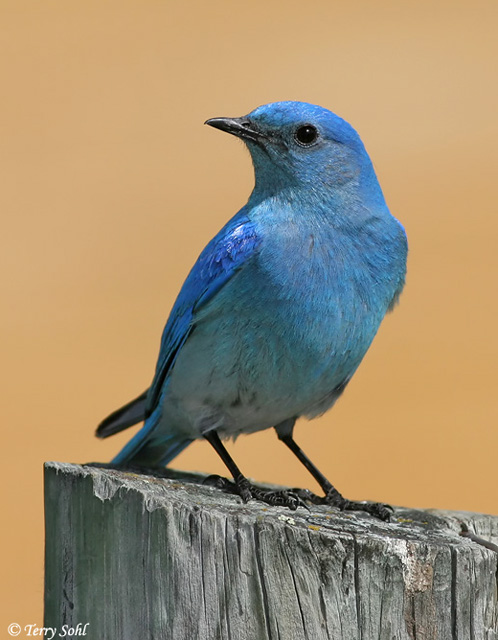
Mountain Bluebirds are well-named, as during the summer breeding season they are typically found in moderate to high-elevation meadows and other semi-open areas found amongst the interior mountain areas of the western United States. During winter months they may descend to lower elevations, including farmland and other semi-open habitats. Mountain Bluebirds are distinguished from the other bluebirds by the male's all blue coloration, without rusty underparts (see photo to the right). Females are much plainer (see photo #3 at the bottom of the page), with primarily bluish-gray plumage. The Mountain Bluebird is a summer resident (and occasional winter resident) in the western part of the state, only rarely appearing in the east during migration and in the winter months.
Habitat
Prefers open territory with some trees and other areas that provide nesting cavities and perches, but they are also sometimes found in treeless areas. Found not only in mountain meadows and clearings, but sometimes at lower elevation rangeland, farmland, and sagebrush regions.
Diet
Mostly insects and spiders, with caterpillars and grasshoppers favored items in many areas if they are available. They will also feed on berries and some seeds, particularly during the winter months. .
Behavior
Mountain Bluebirds typically hunt by observing from a perch and flying out to catch insects in mid-air, or grabbing them from the ground or vegetation. They are also able to hover and observe conditions below, dropping down on prey once it is spotted. Overall, they are more accomplished aerial hunters than other bluebird species.
Nesting
May through July. The nest of a Mountain Bluebird is placed in a cavity, such as an abandoned woodpecker cavity in a tree, or in a natural cavity/space amongst rocks. With increased competition for nesting cavities with introduced species such as House Sparrows and European Starlings, specially built nesting boxes for bluebirds now make up a majority of nesting activities in some areas. The female alone builds the nest within the cavity, using grasses and other material to line the bottom of the cavity. She lays 4 to 7 eggs, and she alone incubates them. The eggs are incubated for 12 to 14 days, with the young fledgling from the nest about 3 weeks after hatching.
Song
The song of a Mountain Bluebird is a repetitive series of soft, sweet, short warbling phrases that are often repeated for long periods of time. The call is a simple sweet pew note.
Migration
Summers in the western U.S. northward through western Canada and into Alaska. Winters in the southwest quarter of the United States, southward through Mexico.
Interactive eBird Map
Click here to access an interactive eBird map of Mountain Bluebird sightings
Similar Species
There are two other bluebird species in North American that could potentially be confused with it, but typically make identification straightforward.
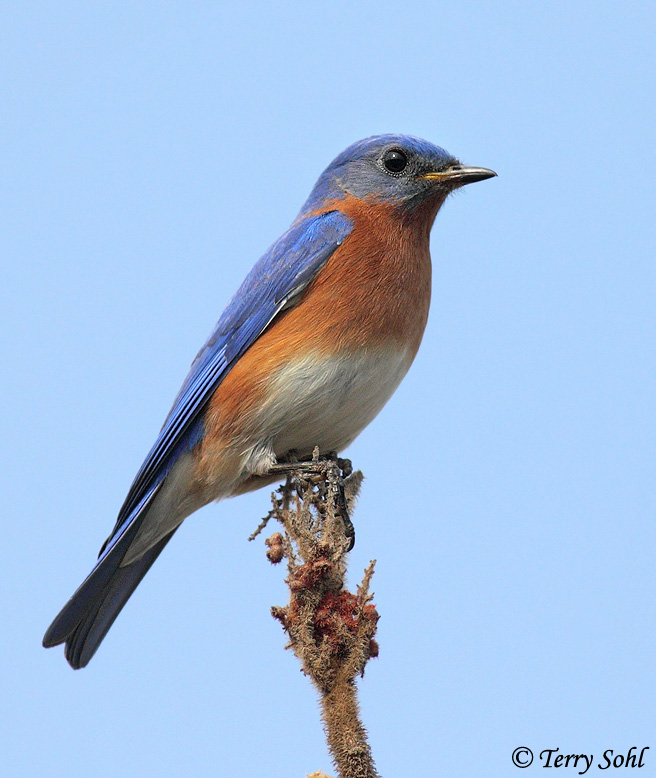
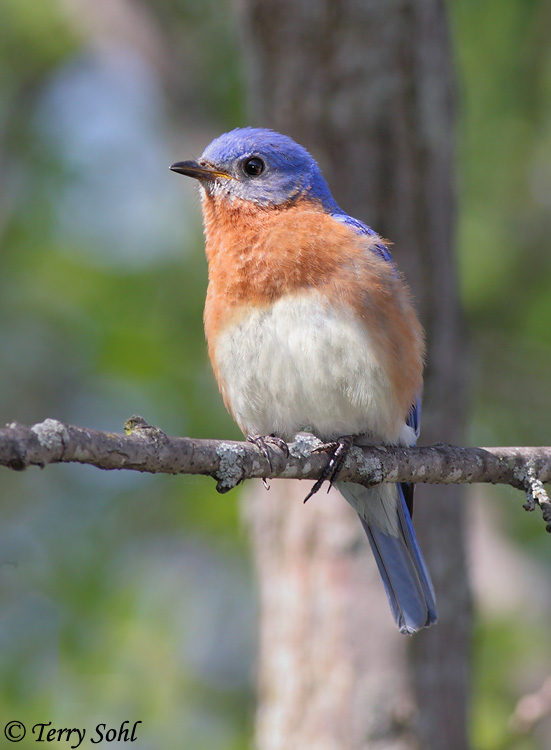
- Eastern Bluebird - Eastern Bluebirds have some overlap in range with Mountain Bluebirds in the far western part of the state. Male Eastern Bluebirds have a rusty orangish color on their blanks and breast that is lacking from their male Mountain Bluebird counterpart. They also are a deeper blue overall than Mountain Bluebirds. Females are a bit more difficult to distinguish, but female Eastern Bluebirds have a richer orangish wash on their breast and flanks than do female Mountain Bluebirds, who typically have gray underparts.
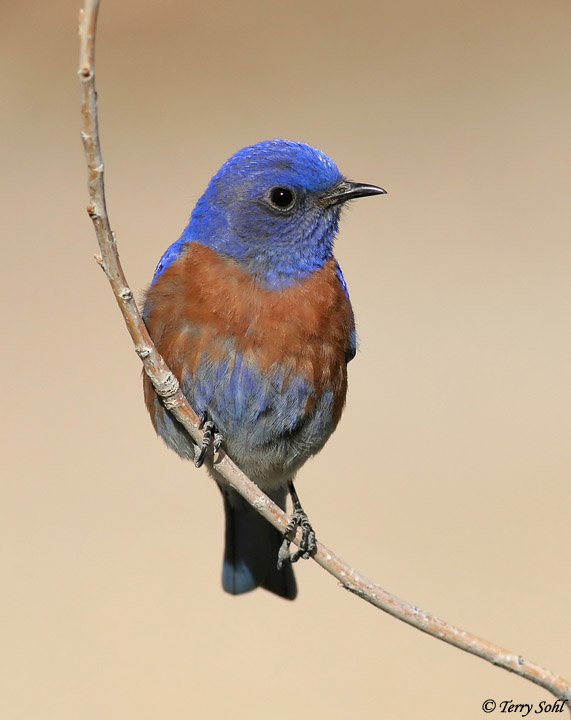
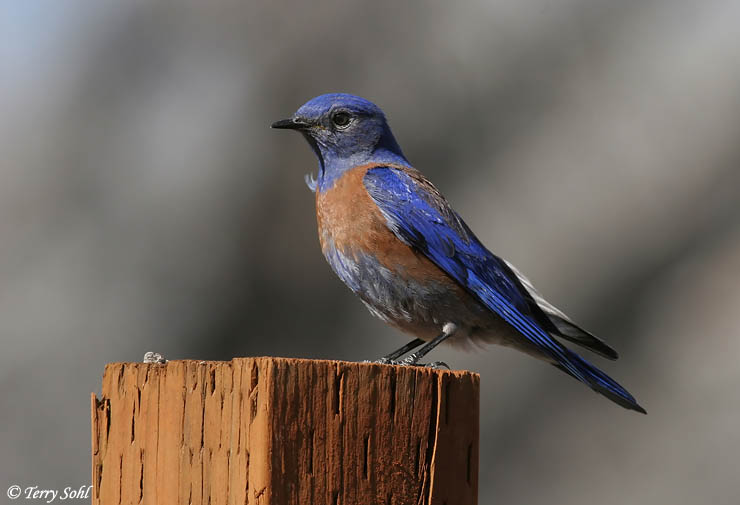
- Western Bluebird - Western Bluebirds are but rare visitors to South Dakota, but they do have extensive range overlap in western North America. Male Western Bluebirds have a bold rusty orange breast and flanks, while male Mountain Bluebirds are blue overall. Male Western Bluebirds also are a deeper blue than a male Mountain Bluebird.
 |
 |
 |
 |
| Eastern Bluebird | Eastern Bluebird | Western Bluebird | Western Bluebird |
Birdfeeders
Will sometimes attend feeders for offered mealworms. They will also occasionally visit feeders that offer soft fruits, or nut meal.
Birdhouses
Will nest in man-made nest boxes that mimic the natural cavities they normally breed in. Nest boxes can be placed in open to semi-open habitats, away from buildings or other man-made structures other than fencelines. Placement near man-made strucutres often results in House Sparrows taking over the nest box. Commercially produced bluebird houses will work quite well for the species. For those building their own, the entrance hole for a Mountain Bluebird nest box should be about 1 3/4 inches in diameter, and placed 5 to 6 inches above the floor of the nest box. Placement on fence posts works well, as Mountain Bluebirds prefer perches near their nest box. Click here for information on bluebird nest box construction and placement.
Conservation Status
Populations appear to be stable, and may be increasing due to increasing placement (and use) of nest boxes. They are found over a wide geographic area and are common in parts of their range. The IUCN considers the Mountain Bluebird to be a species of "Least Concern".
South Dakota "HotSpot"
There are a number of areas in and around the Black Hills that support Mountain Bluebirds in the summer. Custer State Park always holds good numbers of Mountain Bluebirds in the summer. The famed Wildlife Loop Road winds through large open grasslands along much of its route. Mountain Bluebirds are often seen sitting on fencelines on this drive, and bluebird boxes are present on parts of the drive. Open grassy areas amongst the Ponderosa Pines of the Black Hills often have Mountain Bluebirds. Again, look for birds on the top of fencelines adjacent to roads, or on other similar obvious perches in grassland and pasture regions.
Photo Information
May 25th, 2008 - Custer State Park, Black Hills, South Dakota - Terry Sohl
Audio File Credits
- 1Andrew Spencer. Recorded in Conejos County, Colorado on July 2nd, 2007. Original recording and information available on xeno-canto.
- 2Jonathon Jongsma. Recorded in Custer State Park of South Dakota on June 21st, 2015. Original recording and information available on xeno-canto.
