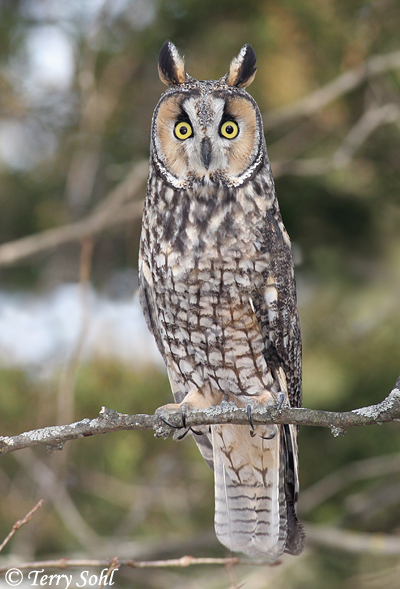
ID Keys: Horizontal stripes on belly, long ear tufts, slimmer than
Great Horned Owl
The Long-eared Owl is often overlooked, due to its extreme
nocturnal habits and ability to "freeze" and blend in with its habitat
. Often the best means of locating one is to find the large accumulation
of droppings and pellets underneath its roost, which it tends to use for many
days at a time. Groups of Long-eared Owls are sometimes found roosting
together in conifer groves during the winter.
Habitat
Generally
prefers mixed habitats of trees for roosting with nearby open areas for hunting,
but can be found in a very wide variety of habitats.
Diet
Primarily feeds on small rodents. Will also eat
small birds, lizards, frogs, snakes, and bats.
Behavior
Primarily hunts at night, usually by
flying slowly close to the ground, locating prey by both sight and sound.
Nesting
April through June in South Dakota. The Long-eared Owl usually does not build its own nest but instead takes over old stick nests made by crows, magpies, hawks, or squirrels in dense groves or shelterbelts. The female lays 4 to 6 eggs, incubates while the male brings food, and the young often climb onto nearby branches before they can truly fly. Concealed nesting sites in thick conifers or riparian trees help this secretive owl remain hidden during the breeding season.
Song
The Long-eared Owl is usually quiet, but in the breeding season the male gives a low, evenly spaced series of deep hooo notes that can carry surprisingly far at night. It also produces sharp barks, catlike squeals, and hissing sounds around the nest when disturbed.
Migration
Some in the northern part of its range move south in the winter. Others
throughout its range may be permanent residents, while still others may be
nomadic, following available food supplies.
Great Horned Owl, Short-eared Owl. The Long-eared Owl is slimmer and more finely streaked than the bulky Great Horned Owl, with a narrow body, orange facial disk, and very long close-set ear tufts that give it a stretched, upright look. Great Horned Owls are much larger, heavier-chested, and broader-headed, with widely spaced ear tufts and bold white throat patch. Compared with the Short-eared Owl, Long-eared Owl is darker, more heavily patterned, and far more likely to sit hidden in dense trees, while Short-eared Owl has tiny barely visible ear tufts, paler underparts, and usually hunts low over open grasslands by day.