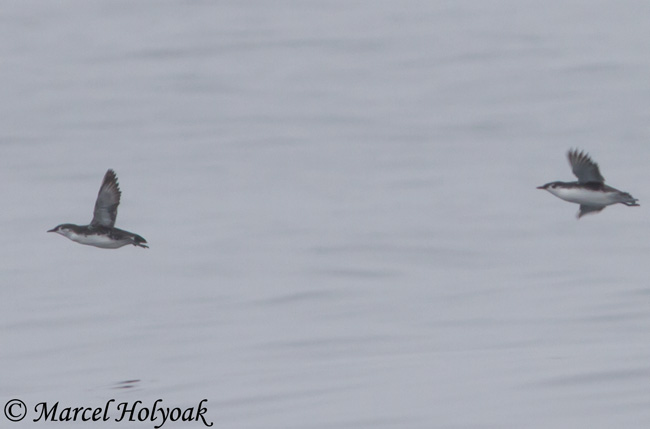
The Guadalupe Murrelet is a "new" species, with the Scripp's and Guadalupe Murrelet's recently split (2012) from what was formerly considered one species, the Xantus's Murrelet. They are a very uncommon bird, only found nesting on a handful of islands from Guadalupe Island in the north, to the San Benito Islands in the south. Introduced predators such as rats have devastated some former breeding colonies.
Habitat
Found on a few select islands off the Pacific Coast, using locations with protected nesting sites, such as rocky crevices or vegetative cover. Outside of the breeding season, typically found far from the mainland, sometimes close to nesting islands, but often far out to sea.
Diet
The Guadalupe Murrelet feeds primarily on small fish such as anchovies, sardines, and lanternfish, along with squid and crustaceans. Most feeding occurs close to breeding islands, although birds range farther offshore outside the nesting season.
Behavior
Forages by diving and swimming under the water in search of food items. Doesn't feed in flocks or by itself, but is almost always found foraging in pairs.
Nesting
The Guadalupe Murrelet doesn't build a nest. The female lays 2 eggs directly on the ground, typically in a rocky crevice, under a bush, or in another protected area. Both parents help to incubate the eggs. Hatchlings typically leave the nest within a day or so after hatching, often making a perilous leap into the water below. Once in the water, the parents reunite with the young and feed and tend to them.
Song
The Guadalupe Murrelet is generally silent while at sea but becomes more vocal around breeding colonies at night. Its calls consist of high-pitched whistles, squeaks, and soft chattering notes used by mates to locate one another and communicate at nesting sites. Like many alcids, it minimizes daytime vocal activity at colonies to reduce the risk of attracting predators.
Migration
The Guadalupe Murrelet makes seasonal movements along the Pacific coast after the breeding season but is not considered a long-distance migrant. It breeds on islands off the west coast of the Mexico, then disperses northward into offshore waters of California and occasionally farther north. Most individuals remain in marine waters relatively close to the Pacific coast throughout the year.
Interactive eBird Map
Click here to access an interactive eBird map of Guadalupe Murrelet sightings
Similar Species
In range, most likely to be confused with Scripp's Murrelet , Craveri's Murrelet, Ancient Murrelet , and Marbled Murrelet.
Compared with Scripps's Murrelet: The Guadalupe Murrelet has a darker face with more black around the eye and less extensive white on the face than the Scripps's Murrelet. Guadalupe Murrelets also tend to have a cleaner white throat and underparts with a sharper contrast between the dark upperparts and white face.
Compared with Craveri's Murrelet: The Guadalupe Murrelet has a bold black-and-white facial pattern and white underparts, whereas the Craveri's Murrelet is darker overall with dusky underparts and much less contrasting facial markings. Craveri's Murrelets also have a heavier bill and a more uniformly dark appearance.
Compared with Ancient Murrelet: The Guadalupe Murrelet is smaller and lacks the striking white head stripes and long black crest of the Ancient Murrelet in breeding plumage. Ancient Murrelets are bulkier and have a more boldly patterned head and neck.
Compared with Marbled Murrelet: The Guadalupe Murrelet has crisp black-and-white breeding plumage with clean white underparts, unlike the Marbled Murrelet, which is mottled brown above and below during the breeding season. Marbled Murrelets also have a shorter, stubbier bill and are unique among these species in nesting primarily in large old-growth forest trees rather than on offshore islands.
Conservation Status
The Guadalupe Murrelet is classified as Endangered by the International Union for Conservation of Nature because of its small population and restricted breeding range on a few islands off the Pacific coast of Mexico. Major threats include introduced predators at nesting colonies, oil pollution, fisheries interactions, and climate-driven changes that affect marine food supplies. Intensive conservation efforts, including the removal of invasive mammals from breeding islands, have improved nesting success, but the species remains at high risk and requires continued protection.
Further Information
Photo Information
Photo taken by Marcel Holyoak - September 18th, 2010 - Half Moon Bay, California - Photo licensed under Creative Commons Attribution NonCommercial NoDerivs 2.0 Generic License
