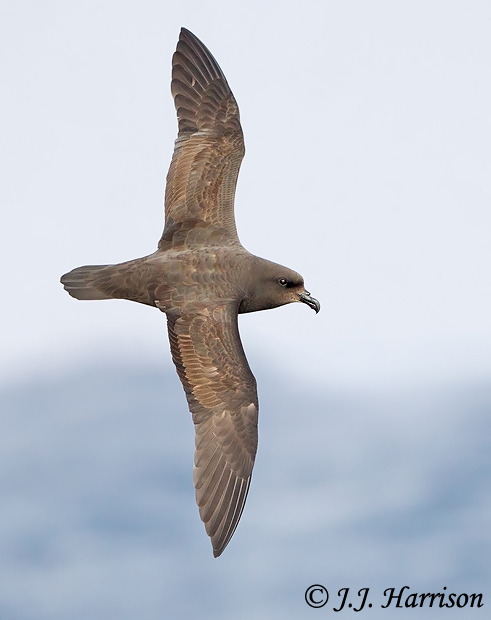
The Great-winged Petrel, also known as the Gray-faced Petrel, is a seabird of the far southern oceans. They breed in scattered locations throughout the southern oceans, from the coasts of southern Australia and northern New Zealand, to islands in the south Atlantic and Indian Oceans. Non-breeding birds wander throughout the southern hemisphere, but they have occasionally been found in the northern hemisphere as well. North American records consist of a handful of sightings off the coast of California.
Habitat
Found in scattered areas in the southern oceans during the breeding season, using coastline ridges and scattered island groups as nesting colonies. Pelagic at other times of the year.
Diet
The Great-winged Petrel feeds primarily on squid, fish, and crustaceans captured at or near the ocean surface. It also consumes other marine invertebrates and occasionally scavenges behind fishing vessels when food is available.
Behavior
The Great-winged Petrel is a highly pelagic seabird that spends nearly all of its life over the open ocean, coming to land only to breed. It flies with powerful, graceful, arcing flight, using stiff wings to soar efficiently over waves while searching for prey. During the breeding season, adults return to remote island colonies at night, where they nest in burrows or among dense vegetation to reduce the risk of predation. Most foraging takes place at night, when many prey species rise closer to the surface, although the bird also feeds during the day over productive offshore waters.
Nesting
Nesting typically occurs near the base of a small shrub or other plant, or between tree roots. A single egg is laid, with an incubation period of about 8 weeks. Both parents help feed and tend to the young after hatching.
Song
The Great-winged Petrel is generally silent while at sea but becomes vocal at breeding colonies after dark. Its calls include a variety of deep moans, wails, growls, and harsh cackling notes used for communication between mates and territorial interactions around nesting burrows. These nocturnal vocalizations are often loud and eerie, carrying across breeding colonies on remote islands.
Migration
The Great-winged Petrel is a highly pelagic species that disperses widely across the southern oceans after the breeding season. It breeds on islands in the southern Indian and South Atlantic Oceans, then ranges broadly over the South Atlantic, South Indian, and South Pacific Oceans while foraging. Rather than following narrow migration routes, it undertakes extensive seasonal movements across open ocean waters between breeding colonies and nonbreeding feeding areas.
Interactive eBird map
Click here to access an interactive eBird map of Great-winged Petrel sightings
Similar Species
Similar to several shearwater species, including Sooty Shearwater , Flesh-footed Shearwater , and Short-tailed Shearwater .
Compared with Sooty Shearwater: The Great-winged Petrel has a shorter, thicker bill, broader wings, and a more buoyant, soaring flight than the Sooty Shearwater. Sooty Shearwaters fly with long, low shearing glides close to the waves, whereas Great-winged Petrels show higher, more arcing flight and a bulkier head and bill.
Compared with Flesh-footed Shearwater: The Great-winged Petrel has a stout black bill and uniformly dark legs, while the Flesh-footed Shearwater has a distinctive pale pink bill with a dark tip and flesh-colored legs. Great-winged Petrels also have broader wings and a more rounded-headed, petrel-like appearance.
Compared with Short-tailed Shearwater: The Great-winged Petrel is larger and more heavily built than the Short-tailed Shearwater, with a thicker bill and broader wings. Short-tailed Shearwaters have a slimmer profile and typically fly lower over the water with faster, more direct shearing flight, whereas Great-winged Petrels soar higher with slower, sweeping wingbeats and long glides.
Conservation Status
The Great-winged Petrel is classified as Least Concern by the International Union for Conservation of Nature because of its broad distribution across the southern oceans and its relatively large global population. However, some breeding colonies are threatened by introduced predators, habitat degradation, plastic pollution, and bycatch in commercial fisheries. Despite these localized threats, the species is not currently considered globally threatened.
Further Information
Photo Information
Photo taken by J.J. Harrison - May 27th, 2012 - Near Tasmania - Licensed under Creative Commons Attribution ShareAlike 3.0 Unported License
