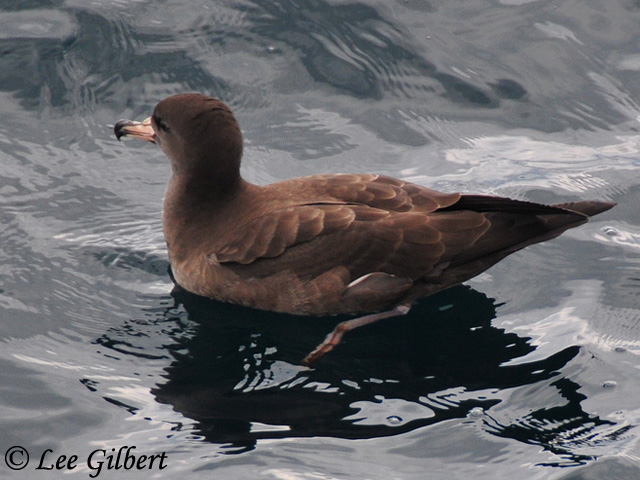
The Flesh-footed Shearwater is a large shearwater species that breeds in the southwestern Pacific and the Indian Oceans. In North America, they are occasionally seen off the West Coast, where they are most often found in conjunction with the smaller Sooty Shearwater. As with many marine species, the Flesh-footed Shearwater is attracted to human fishing activity, and they sometimes fall prey to longline fisheries when they grab baited hooks. However, at the current time, populations appear to be stable.
Habitat
The Flesh-footed Shearwater is a pelagic seabird that spends most of its life over open ocean waters, particularly in subtropical and temperate marine environments. It breeds on offshore islands, nesting in burrows on grassy slopes, coastal heathlands, and sparsely vegetated terrain. Outside the breeding season, it ranges widely across the Pacific and Indian Oceans, often occurring far from land over deep offshore waters.Diet
The Flesh-footed Shearwater feeds primarily on fish, squid, crustaceans, and other marine organisms captured near the ocean surface.Behavior
Feeds by diving and swimming underwater in pursuit of prey, either by making short dives from flight, or by swimming on the ocean's surface and diving. They will also sometimes swim and directly pluck prey items that are close to the ocean's surface. The species also readily scavenges behind fishing vessels and may consume fishery discards when available.Nesting
The Flesh-footed Shearwater nests in burrows excavated in soil on offshore islands, often in colonies that range from scattered pairs to thousands of birds. Each breeding pair typically lays a single white egg deep within the burrow, where it is protected from predators and harsh weather. Both parents share incubation duties and care for the chick, making long foraging trips at sea to bring food back to the nest.Song
The Flesh-footed Shearwater is generally silent while at sea but becomes quite vocal at breeding colonies, especially at night. Its calls include a variety of harsh moans, groans, cackles, and guttural growls used for communication between mates and for defending burrows. These vocalizations often create a noisy and distinctive atmosphere within active nesting colonies.Migration
Breeds on islands in the southwest Pacific near New Zealand, the west coast of Australia, and select locations in the Indian Ocean and Arabian Sea. Non-breeding birds disperse, with birds in the Indian Ocean moving northward and westward, while Pacific Birds move up the western side of the Pacific, ranging as far north as the Aleutian Islands. They are relatively scarce visitors to the eastern side of the Pacific.Interactive eBird Map
Click here to access an interactive eBird map of Flesh-footed Shearwater sightingsSimilar Species
Sooty Shearwater: The Flesh-footed Shearwater has a pale pink bill with a dark tip and flesh-colored legs, whereas the Sooty Shearwater is darker overall with a slimmer dark bill and dark legs. Flesh-footed Shearwaters also tend to appear browner and bulkier than the more uniformly dark Sooty Shearwater.
Short-tailed Shearwater: The Flesh-footed Shearwater is larger and has a noticeably heavier pink bill and pale legs. The Short-tailed Shearwater is smaller, darker, and has a slender dark bill and dark feet.
Pink-footed Shearwater: The Flesh-footed Shearwater is darker brown overall and has a shorter, stouter bill. The Pink-footed Shearwater typically shows a paler head and underparts, a longer bill, and more contrasting plumage, especially in good lighting.
