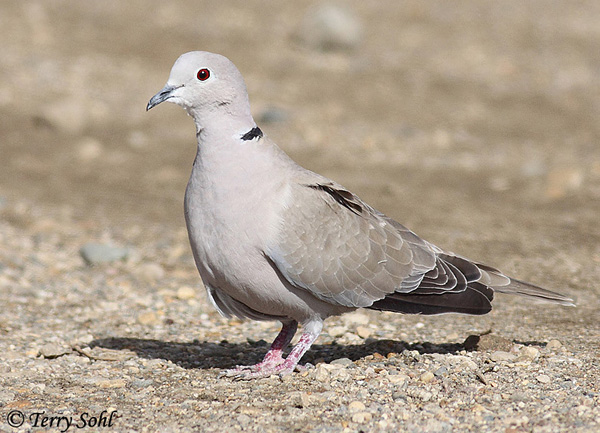
ID Keys: Pale brownish gray with half ring on back of the neck
The next big successful "exotic" species (ala the House
Sparrow or European Starling) accidentally
introduced into the United States may well be the Eurasian Collared Dove.
After being introduced into the Bahamas in the mid 1970's, they rapidly spread
into the southeastern U.S. and continue to grow in numbers and range.
There is precedence, as this bird originally from the Middle East spread rapidly
throughout Eurasia during the 20th century. Like the House
Sparrow, they are often found in the vicinity of human activity from which
they definitely benefit.
Habitat
The Eurasian Collared-Dove is commonly found in open and semi-open habitats, including agricultural areas, towns, suburbs, parks, and rural communities. It thrives around human habitation, where scattered trees, utility lines, and buildings provide nesting and roosting sites. Unlike many native doves, it readily occupies developed landscapes and has successfully expanded its range across much of the world.
Diet
The Eurasian Collared-Dove feeds primarily on seeds and grains, including those from grasses, weeds, and cultivated crops. It also consumes small amounts of berries, fruits, and occasionally insects or other invertebrates. Most foraging takes place on the ground, often in agricultural fields, feedlots, and around bird feeders.
Behavior
The Eurasian Collared-Dove is a social species that is often seen alone, in pairs, or in small flocks, especially outside the breeding season. It spends much of its time perched on utility lines, fences, and trees, descending to the ground to forage for seeds and grains. During courtship, males perform conspicuous display flights and repeated bowing displays while giving their characteristic calls.
Nesting
May through August in South Dakota. The Eurasian Collared-Dove builds a simple, loosely constructed platform nest of twigs, usually placed in a tree, shrub, or on a man-made structure. The female typically lays two white eggs, and both parents share incubation and care of the young. In favorable climates, this species may raise several broods during a single breeding season.
Song
The Eurasian Collared-Dove is best known for its distinctive, rhythmic three-part cooing call, often described as coo-COO-coo. Males frequently repeat this call from exposed perches to advertise territory and attract mates. The species also produces a variety of softer coos, grunts, and wing noises during courtship and social interactions.
Migration
The Eurasian Collared-Dove is a nonmigratory species, with most individuals remaining in the same area throughout the year. Young birds may disperse considerable distances after fledging, which has contributed to the species’ rapid range expansion across Europe and North America. Seasonal movements are generally limited and are driven more by local food availability and weather conditions than by true migration.
Mourning Dove: The Eurasian Collared-Dove is larger and paler than the Mourning Dove and has a distinctive black half-collar on the back of its neck. Mourning Doves have a slimmer appearance, a longer pointed tail with white edges, and lack the black neck collar. In flight, Eurasian Collared-Doves show broad, squared tails, while Mourning Doves display a more tapered, pointed tail shape.