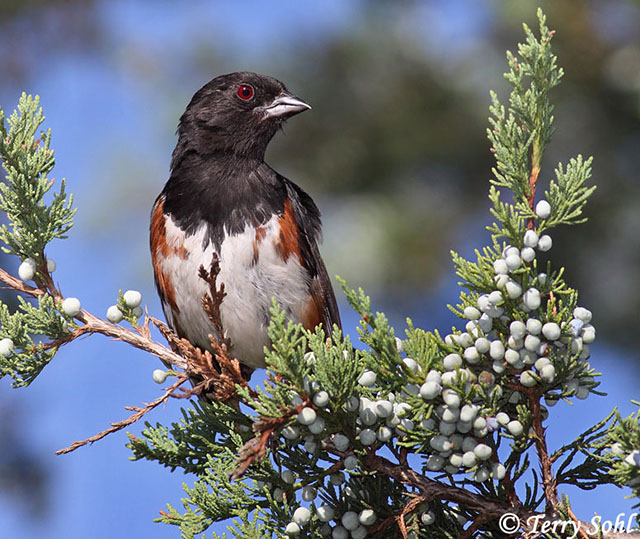
The Eastern Towhee is a large, striking sparrow of shrubby habitats and woodland edges in eastern North America. Males have a black head, back, and upperparts contrasting with rich rufous sides and a white belly, while females are similarly patterned but brown where males are black. The species spends much of its time foraging on the ground, scratching through leaf litter in search of seeds, insects, and other food. In South Dakota, Eastern Towhees are uncommon and localized breeders, occurring primarily in the southeastern part of the state and as migrants elsewhere. Their familiar “drink-your-tea” song and loud rustling in leaf litter often reveal their presence before they are seen.
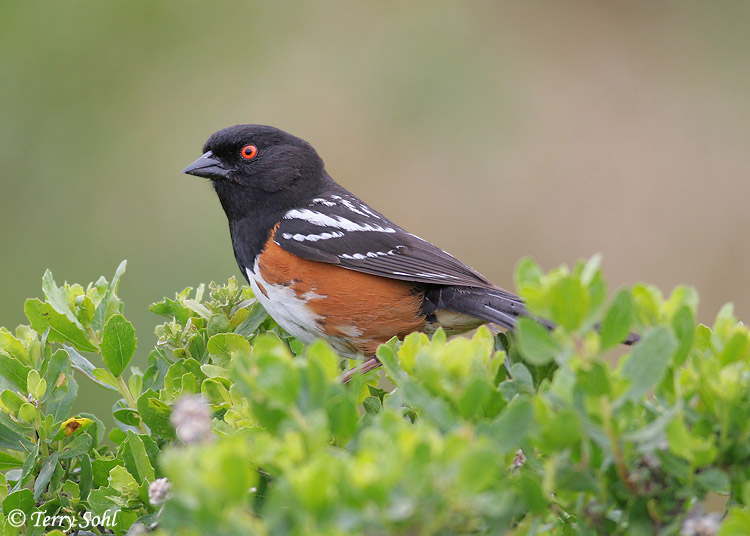
The Eastern Towhee and the Spotted Towhee were formerly considered separate races of the same species, the Rufous-Sided Towhee (a name which is no longer used). The two are very similar, but differ in range, as the Spotted Towhee is mostly a western U.S. bird while the Eastern Towhee is an eastern U.S. bird. The Eastern Towhee also lacks the Spotted Towhee's white spots on its back and wings. The two species may interbreed where their ranges overlap (including in South Dakota).
Habitat
The Eastern Towhee inhabits brushy woodlands, forest edges, shrubby fields, overgrown clearings, hedgerows, thickets, and regenerating forests with dense understory vegetation. It favors habitats that combine thick cover for nesting and protection with nearby open ground for foraging. In South Dakota, it is found primarily in brushy habitats of the southeastern part of the state and along wooded river corridors.
Diet
The Eastern Towhee feeds on a variety of seeds, fruits, berries, and insects. During the breeding season, insects and other invertebrates such as beetles, caterpillars, ants, spiders, and grasshoppers become especially important.
Behavior
The Eastern Towhee spends much of its time on or near the ground in dense shrubs and thickets, where it searches for food by vigorously scratching through leaf litter with both feet. Although often hidden by vegetation, it frequently announces its presence with loud calls and rustling sounds. Males are strongly territorial during the breeding season and sing from exposed perches, while both sexes rely on dense cover for protection from predators.
Nesting
June and July. The nest of an Eastern Towhee is a cup, constructed by the female and made of sticks, bark, leaves, and grasses, and lined with finer grasses or hair. It is usually placed on the ground in a protected location, such as under a bush or next to some other clump of vegetation. They will also occasionally nest in a low bush, rarely over 3 feet from the ground. The female lays between two and six eggs, and she alone incubates them. The young hatch after about 12 days, and fledge from the nest in another 10 or 12 days. In favorable conditions Eastern Towhees will raise more than one brood in a summer.
Song
The classic song of an Eastern Towhee is most often described as aDrink your Tea!. The typical call is a risking, chewEEEE note.
- Click here to hear a singing male Eastern Towhee1
- Click here to hear the call of an Eastern Towhee2
Migration
The Eastern Towhee is a partial migrant whose movements vary across its range. Northern populations, including those breeding in and near South Dakota, typically migrate south in fall to winter across the southeastern United States, while birds in the southern part of the range may remain year-round. Spring migrants return to breeding territories from March through May, with most South Dakota birds present primarily during the breeding season.
Interactive eBird Map
Click here to access an interactive eBird map of Eastern Towhee sightings
Similar Species
Spotted Towhee. The Eastern Towhee is the species found in the eastern US, while the Spotted Towhee is found in the West. Many sites say there's little to no overlap in range, but alas, South Dakota is one area where they can sometimes be found side-by-side. In an area such as Newton Hills State Park, both species can be found, but Eastern Towhees are the much more common of the two species. Visually, the two are virtually identical, except for the spotting on the wings of the Spotted Towhee. Songs are typically different as well, but in the area they overlap, the two species can sometimes interbreed, and sometimes copy bits of each other's song. At Newton Hills, I have personally come across birds that look like Eastern Towhees, but are singing more like a Spotted Towhee.
 |
 |
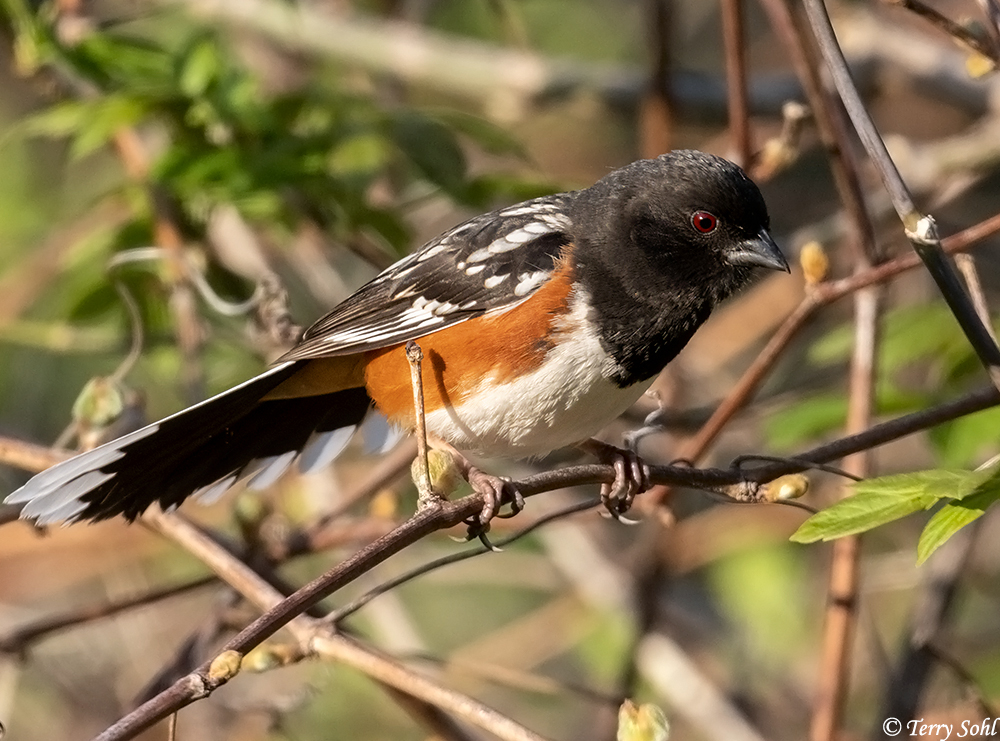 |
| Spotted Towhee | Spotted Towhee | Spotted Towhee |
Bird Feeders
Will attend feeders for suet and some seeds.
Conservation Status
The Eastern Towhee has experienced long-term population declines across portions of its range and is considered a species of conservation concern in some regions. Declines are largely associated with the loss of shrubby habitats, forest succession that reduces dense understory vegetation, development, and changes in land management practices. Despite these trends, the species remains widespread across eastern North America and is still locally common where suitable brushy habitat persists. The IUCN lists the Eastern Towhee as a species of "Least Concern".
South Dakota "Hotspot"
Newton Hills State Park in Lincoln County usually is very reliable for finding Eastern Towhees in the summer months. Look through the brush along Sergeant Creek, near the horse and camping area on the northeastern side of the park. It is one place where you do have to also be on the lookout for their close cousin, the Spotted Towhee. In my part of the state I can also find them pretty easily at the Big Sioux Recreation Area and the Beaver Creek Nature Area near Brandon.
Photo Information
August 28th, 2009 - Newton Hills State Park, South Dakota - Terry Sohl
Audio File Credits
- 1Greg Irving. Recorded in Sherburne, Minnesota on July 28th, 2018. Original recording and information available from xeno-canto.
- 2Peter Boesman. Recorded in Chincoteague National Wildlife Refuge in Virginia on October 23rd, 2017. Original recording and information available from xeno-canto.
