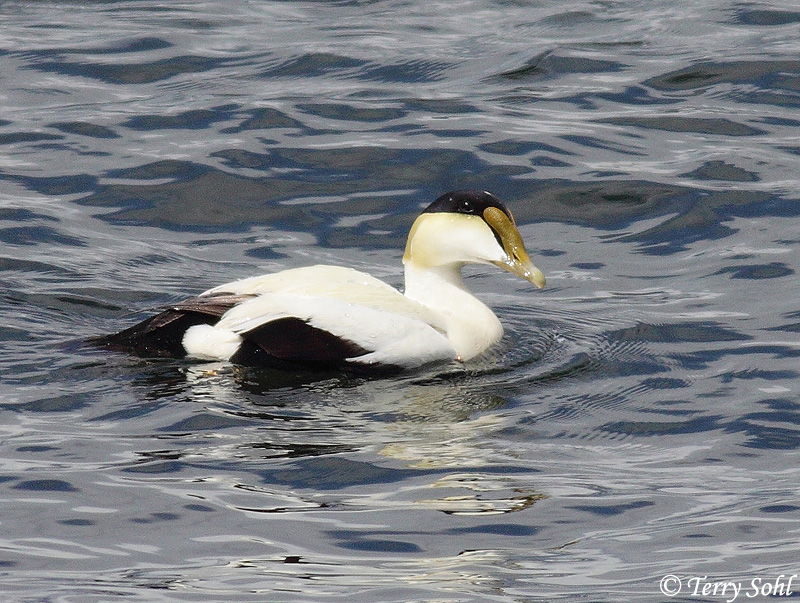
The Common Eider is the largest duck in the Northern Hemisphere and is a characteristic seabird of Arctic and subarctic coastlines. It breeds on rocky islands, coastal tundra, and marine shorelines, often nesting in large colonies where females line their nests with soft insulating down. Common Eiders feed primarily on marine invertebrates such as mussels, clams, sea urchins, crabs, and other shellfish, which they obtain by diving underwater. During winter they gather in large flocks along cold coastal waters of the North Atlantic and Arctic regions. Their dense down feathers provide exceptional insulation and have long been valued for use in bedding and clothing.
Habitat
The Common Eider inhabits marine coastal environments including rocky shorelines, offshore islands, sheltered bays, estuaries, and nearshore ocean waters. It breeds on Arctic and subarctic coasts and islands, often near tundra or rocky terrain, and remains closely tied to saltwater habitats throughout the year.
Diet
The Common Eider feeds primarily on marine invertebrates, especially mussels, clams, snails, sea urchins, crabs, and other shellfish obtained by diving underwater. It may also eat small fish, marine worms, and other aquatic organisms found in coastal waters.
Behavior
The Common Eider is a highly social sea duck that often gathers in large flocks on coastal waters, especially during migration and winter. It spends much of its time diving for shellfish and other marine prey and is well adapted to cold northern oceans, where dense plumage provides excellent insulation.
Nesting
The Common Eider nests on coastal islands, rocky shorelines, and Arctic tundra near marine waters, often in loose colonies. The female builds a shallow ground nest lined with grasses and large amounts of soft down plucked from her breast, creating excellent insulation for the eggs. Typical clutches contain 3–6 eggs, and the female alone incubates and cares for the brood after hatching.
Song
The Common Eider is generally quiet, but males produce distinctive soft, haunting cooing calls often described as a drawn-out ah-oooo during courtship. Females give lower-pitched croaks, grunts, and guttural calls, especially when tending broods or responding to disturbances.
Migration
The Common Eider breeds along Arctic and subarctic coasts of North America, Europe, and Asia and migrates relatively short distances compared to many waterfowl. Most populations move from northern breeding areas to ice-free coastal waters, bays, and estuaries for the winter, often remaining in marine environments throughout the year. Large wintering concentrations occur along the Atlantic Coast of North America, the coasts of northern Europe, and other cold-water regions where open ocean habitat remains available.
Similar Species
The Common Eider is most likely to be confused with other eiders, especially the King Eider and Spectacled Eider. Male Common Eiders lack the colorful orange knob and blue-gray head of the King Eider and do not show the bold pale facial "spectacles" characteristic of the Spectacled Eider. Female and immature eiders can be more challenging to separate, but Common Eiders are generally larger and longer-bodied, with a distinctive wedge-shaped bill profile that extends far up the forehead.
Status
The Common Eider is generally considered a species of low to moderate conservation concern across much of its broad circumpolar range, although some regional populations have experienced declines. Threats include oil spills, entanglement in fishing gear, disturbance at nesting colonies, climate-driven changes in Arctic ecosystems, and reductions in marine food resources. Conservation efforts often focus on protecting coastal nesting islands and maintaining the health of nearshore marine habitats. The IUCN considers the Common Eider to be a species of that is "near threatened".
Photo Information
June 19th, 2008 - Klamath National Wildlife Refuge, California - Terry Sohl
Interactive eBird Map
Click to access the interactive eBird species sightings page for Common Eider
