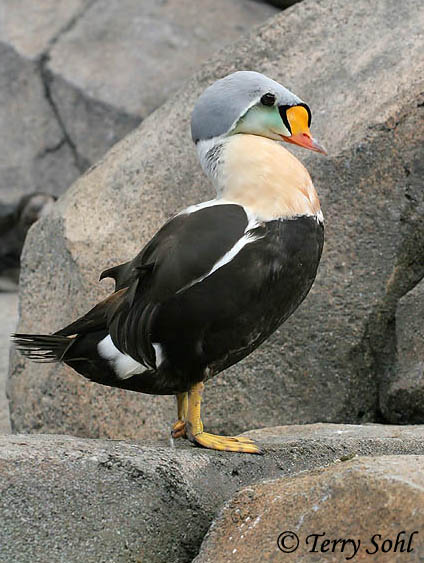
ID Keys: Adult breeding males unmistakable. Non-breeding males
dark brown overall with orange bill. Females tan with dark
"chevron" markings on flanks
The
King Eider is a uniquely patterned sea-duck of the far northern extremes of
North America. They are strongly tied to salt-water habitats in most
seasons, although they can be found on inland freshwater lakes of the far
north during the summer breeding season. They are gregarious and often found
in very large flocks, with flocks in migration sometimes exceeding 10,000
individual birds.
Habitat
During the summer breeding season, they
are found on high Arctic tundra in extreme northern Alaska and Canada.
In winter, they are found a bit further south along the coasts or around the
edge of pack ice.
Diet
The King Eider feeds primarily on marine invertebrates such as clams, mussels, snails, sea urchins, crabs, and other crustaceans obtained by diving underwater. During the breeding season it also eats aquatic insects, insect larvae, and other invertebrates from Arctic ponds and wetlands.
Behavior
The King Eider is a powerful diving sea duck that spends much of its life on cold marine waters, often foraging in deep coastal areas for shellfish and other invertebrates with dives up to 100 feet . Outside the breeding season it is highly social, forming large flocks that may number in the thousands along Arctic and subarctic coastlines.
Nesting
The nest is on a raised patch of ground
near water, and is usually just a depression lined with down and vegetation.
The female alone incubates the eggs. The young feed themselves upon
hatching and leaving the nest, but the female will tend to them and protect
them.
Song
The King Eider is generally quiet, but males produce low, melodious cooing and dove-like calls during courtship displays. Females give harsh croaks, grunts, and guttural calls, particularly when tending broods or responding to disturbances.
Migration
Summers throughout much of the high
Arctic, where it is often found in relatively large numbers. In winter,
moves southward along both costs of North America. Migration is
typically along the coasts, as the species is only very rarely found inland.
Males are distinctive in breeding plumage. Non-breeding males could
possibly be confused with other eiders, but even the relatively drab
non-breeding males are distinctive from other non-breeding eider males.
Females may possibly be confused with a relatively large number of duck
species.
Conservation Status
The King Eider is generally considered a species of low conservation concern across its broad Arctic range, although some regional populations have shown declines. Potential threats include climate change affecting Arctic breeding habitats and sea ice conditions, oil spills, contamination, and changes in marine food resources. Because the species depends heavily on healthy Arctic and marine ecosystems, long-term monitoring remains important. The
IUCN cites it as a species of "Least Concern".
Photo Information
June 25th, 2006 - Alaska Sea
Life Center in Seward, Alaska - Terry Sohl