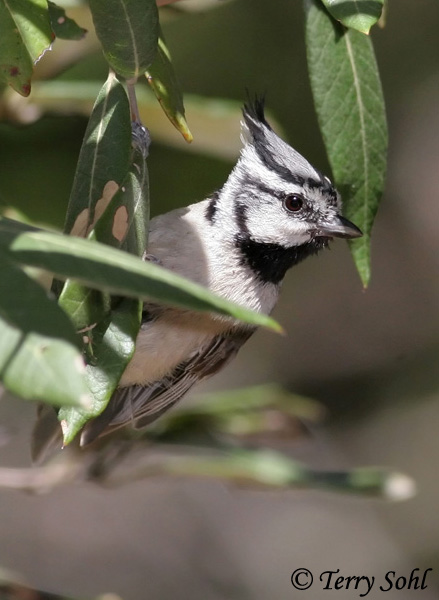
The Bridled Titmouse has a small range within the southwestern United States, but within that range it is very common. The majority of the range of the species is in Mexico. They are the most ornately plumaged of the titmice, with a beautiful head and chin pattern that makes the species look more like a chickadee at a distance, than a titmouse.
Habitat
Found in oak and pine-oak woodlands, typically in areas with live oak species. They can also be found in riparian cottonwoods and willows.
Diet
Feeds on insects, seeds, and acorns.
Behavior
Feeds by gleaning insects from vegetation foliage. They clamber through the vegetation in search of insects, often hanging upside down as they do so. They are very social birds, with small roving flocks typically forming outside of the breeding season.
Nesting
The nest of a Bridled Titmouse is in a cavity in a tree, typically an old woodpecker hole. They have also learned to use artificial nest boxes of appropriate size. It is thought that the female alone incubates the eggs while both parents feed and help tend to the young after they hatch. There is some evidence that Bridled Titmice have complex social and breeding relationships, with birds other than the parents possibly helping to feed and raise young.
Song
Song of a Bridled Titmouse is series of fast whistled phrases.
Click here to hear the song of a Bridled Titmouse
Migration
Considered a permanent resident throughout its range. However, there is some very short-distance elevational movement to lower elevations in winter in some areas.
Interactive eBird Map
Click to access an interactive eBird map of Bridled Titmouse sightings
Similar Species
Distinctive if seen well. In range, perhaps most likely to be confused with Mountain Chickadee , in terms of plumage, but structural differences (and crest) are obvious with Bridled Titmouse.
Conservation Status
Common even within its small U.S. range, populations appear to be stable. The IUCN lists the Bridled Titmouse as a species of "Least Concern" .
Further Information
- eBird - Bridled Titmouse
- Audubon Field Guide - Bridled Titmouse
- Cornell Lab of Ornithology - All About Birds: Bridled Titmouse
Photo Information
Photo taken on May 4th, 2008 - Ramsey Canyon in southern Arizona - Terry Sohl
