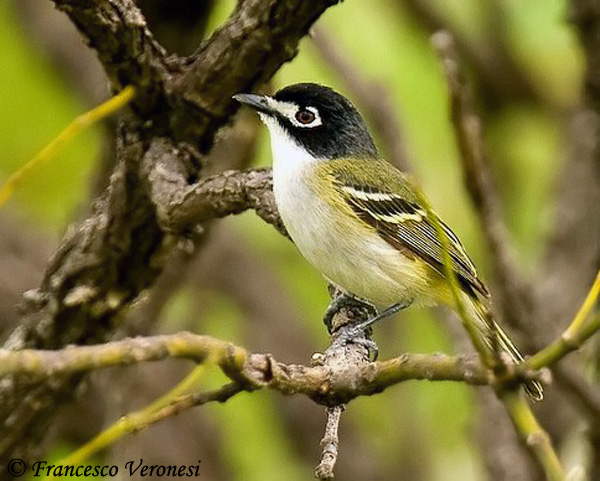
The Black-capped Vireo is the smallest of our vireo species, with a limited United States range in the southern Great Plains. There, they are found in shrubland habitats during the summer breeding season. Numbers of Black-capped Vireos have declined precipitously in recent decades. The decline has largely been blamed on increased numbers of Brown-headed Cowbirds, parasitic nesters that lay their eggs in the nests of other birds. Habitat fragmentation has led to increased numbers of the Cowbirds, and Black-capped Vireos are particularly susceptible to Cowbird parasitism, given the relatively long incubation period for their eggs. Cowbird eggs laid in the nest of a Black-capped Vireo usually hatch much earlier than the Vireo eggs, leading the parents to raise a family of Cowbirds rather than Vireos.
Habitat:
Found in a variety of brushy habitats, including chaparral, pinyon-juniper shrublands, and arid thorn scrublands.
Diet:
Feeds mostly on insects and spiders, particularly during the summer breeding season. They may also feed on small berries, particularly during the winter.
Behavior:
Forages by climbing and flitting actively through the foliage and branches of brush and shrubs. They will also occasionally forage on the ground.
Nesting:
The nest of a Black-capped Vireo is a small hanging cup placed in the fork of a small branch, built of grasses, weed stems, leaves, bark fibers, and spider webs. The female lays 2 to 5 eggs, and both parents help to incubate them. When the eggs hatch, both parents help tend to the young and feed them. The young leave the nest after about 12 days, but typically stay near the parents for several weeks after fledging.
Interactive eBird Map:
Click to access an interactive eBird map of Black-capped Vireo sightings
Song:
The song of a Black-capped Vireo is a series of complex, chattering phrases.
Migration:
Summers in the southern Great Plains. Winters in western Mexico.
Similar Species:
Blue-headed Vireo. The Blue-headed Vireo is characterized by its slate-blue hood, crisp white spectacles around the eyes, and olive-green back. In contrast, the Black-capped Vireo features a striking jet-black cap (in males) that contrasts with a white eye-ring and a distinctive reddish or dark eye, and it is significantly smaller in size.
Conservation Status:
The Black-capped Vireo was officially removed from the Federal List of Endangered and Threatened Wildlife in 2018 following a successful recovery from a low of just 350 birds to over 22,000 individuals. Despite this federal delisting, it remains a species of conservation concern and is currently classified as Near Threatened on the IUCN Red List due to its continued reliance on active management for habitat preservation and cowbird control.
Photo Information:
Photo taken by Francesco Veronesi - April 23rd, 2009 - Texas - Photo licensed under Creative Commons Attribution NonCommercial ShareAlike 2.0 Generic License.
