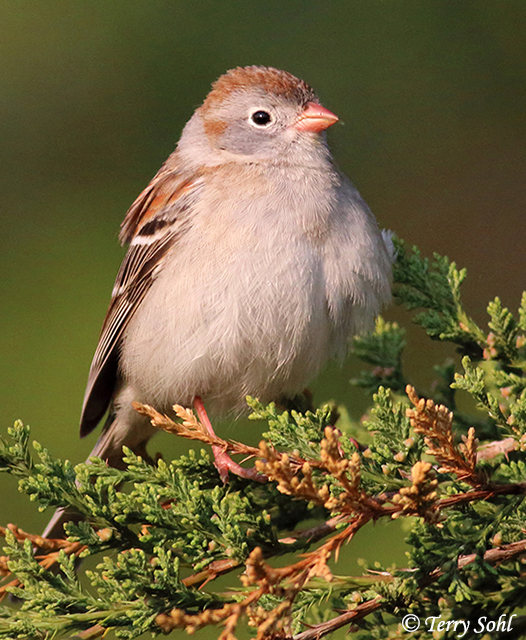
The Field Sparrow is a small, long-tailed sparrow of brushy fields and shrublands. Their energetic songs can be heard on even the hottest of days when most other birds are temporarily dormant. They have greatly benefited from man's forest clearing activities, as the brushy second-growth forest is the perfect habitat for them. Numbers of Field Sparrows exploded across the eastern United States as deforestation removed the thick, nearly continuous forest cover in the 19th and early 20th centuries. As forests grew back, numbers declined, but given the amount of scrubby second-growth forest and brushy fields associated with human activity, numbers are still likely higher than they were prior to European settlement of North America. In South Dakota, they are primarily found in the southeastern part of the state, although scattered populations can be found in suitable locations elsewhere in the state as well.
Habitat
Prefers open areas with scattered brush or other taller cover, such as brushy fields, hedgerows and fencelines. They will sometimes be found along woodland edges as long as open areas are adjacent to the woodland.
Diet
The majority of the summer diet is insects and spiders, along with seeds. The majority of the winter diet is seeds.
Behavior
Field Sparrows typically forage low in brush or other vegetation, or on the ground. Males are very frequent singers from higher perches, however, as they defend territory.
Nesting
June and July. The nest of a Field sparrow is built by the female who uses grasses to weave a small cup, and then lines it with finer grasses, fur, feathers, and/or rootlets. It is often placed on the ground at the base of a shrub or hummock of grass, but may also be placed in the low branches of a shrub. The female lays 2 to 5 eggs, and she alone incubates them. The eggs hatch after 12-15 days.
Song
The song is unmistakable, a series of soft, melodic monotone notes that gain in speed as the song progresses. The call note is a short, very muted tsit.
- Click here to hear the song of a Field Sparrow1
- Click here to hear the short call notes of a Field Sparrow2
Migration
They are permanent residents throughout much of the eastern United States. Birds towards the northern end of their range, such as those in the Dakotas, do migrate southward in the winter.
Interactive eBird map
Click here to access an interactive eBird map of Field Sparrow sightings
Similar Species
Field Sparrows have a very simple plumage pattern, which distinguishes from many sparrow species that have extensive streaking or very strong facial markings. Here are the species most likely to be confused with a Field Sparrow:
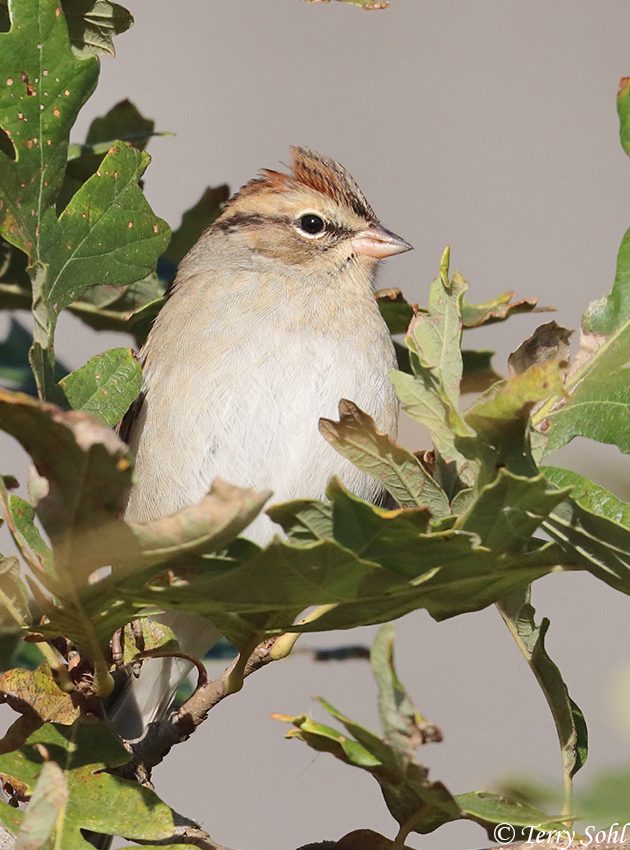
- Chipping Sparrow - Two common sparrow species (in southeastern South Dakota) which overlap in range and habitat much of the time. As is the case with most other sparrow species, the Chipping Sparrow has stronger markings on its face than a Field Sparrow, with an obvious dark line through the eye the most obvious difference. Mature breeding adult Chipping Sparrows also have a dark black-ish gray bill, compared to the pink bill of a Field Sparrow. Note however that the bill of an immature or non-breeding adult Chipping Sparrow can look similar to that of a Field Sparrow.
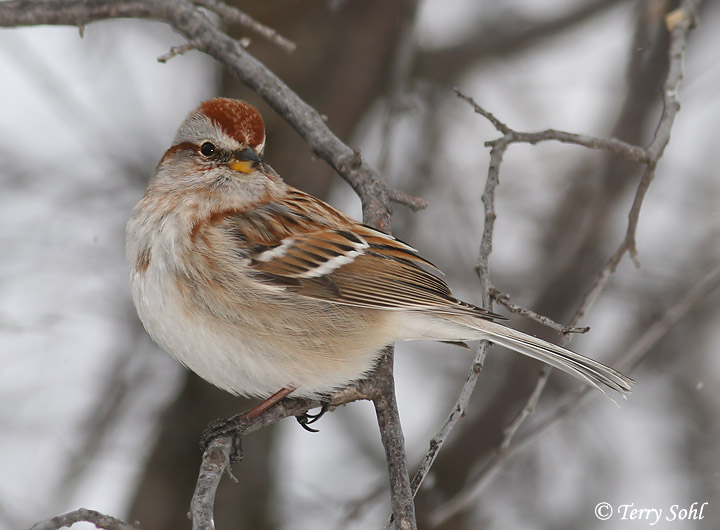
- American Tree Sparrow - In terms of appearance, the American Tree Sparrow is probably the most similar species to the Field Sparrow. However, in South Dakota, the time of year is one way to differentiate Field Sparrows from American Tree Sparrows. American Tree Sparrows are migrants in South Dakota, only here during the winter months and in migration. Field Sparrows are summer breeding birds in the state. It might be possible to have both species present during the spring and fall migration (although I've never found American Tree Sparrows to be particularly early fall migrants, so straggler migrant sparrows in the spring might be the most likely to be present when Field Sparrows are around). For appearance, American Tree Sparrows have a yellow and black bill compared to the pink bill of a Field Sparrow, and they lack the Field Sparrow's white eye ring.
- White-crowned Sparrow (immature) - Adult White-crowned Sparrows have (surprisingly!) a strong black and white crown pattern that easily distinguishes them from Field Sparrows. However, during the fall, immature (first year) birds have a brown crown that is somewhat similar to that of a Field Sparrow, and they also have a light-orangish bill that could potentially be confused with that of a Field Sparrow. Immature White-crowned Sparrows, however, have a dark eye stripe not found on Field Sparrows. They also have a lack of the obvious white eye ring found on Field Sparrows.
 |
 |
 |
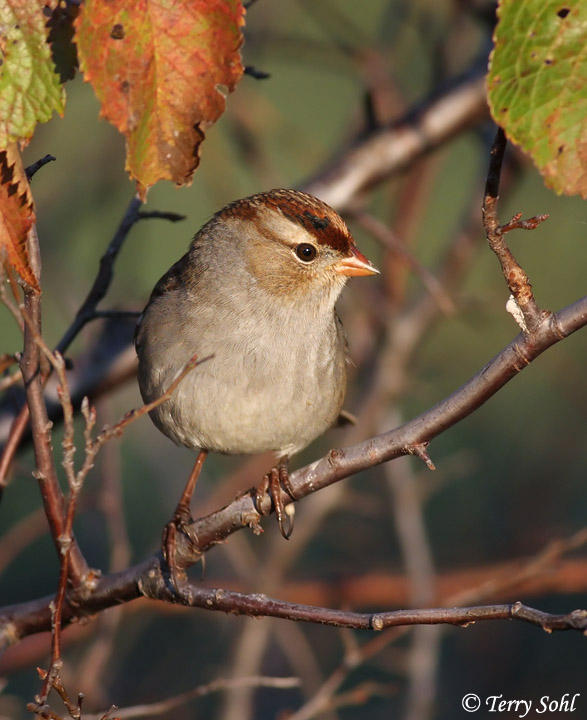 |
| Chipping Sparrow | Chipping Sparrow | American Tree Sparrow | White-crowned Sparrow |
Conservation Status
Numbers increased greatly following European colonization, due to clearing of forest lands. Numbers have declined over the past century as forest areas have regrown. Still very common in parts of its range, and found over a broad geographic area. The IUCN considers the Field Sparrow to be a species of "Least Concern".
Bird Feeders
Will occasionally attend feeders for various small grains.
South Dakota "HotSpot"
They are common in suitable habitat in the southeastern part of South Dakota. They like brushy areas, often in semi-open areas though like brushy fields or grassy areas with scattered small trees. I always find them in good numbers in the Big Sioux Recreation Area in Brandon every summer. The grassy area with scattered brush and trees near the park entrance always holds Field Sparrows in the summer, and you can't help but hear their songs as you walk through the park. Newton Hills State Park also always holds Field Sparrows in the summer. The "Horse Camp" area and the nearby scattered sumac and cedars always hold summer breeding birds, as do select other areas of the park with sumac or other shrubs.
Photo Information
May 5th, 2016 - Newton Hills State Park, South Dakota - Terry Sohl
Audio File Credits
- 1Bobby Wilcox. Photo taken near Des Moines, Iowa on April 8th, 2019. Original recording and information from xeno-canto.
- 2William Whitehead. Photo taken in Monmouth County, New Jersey on October 25th, 2019. Original recording and information from xeno-canto.
