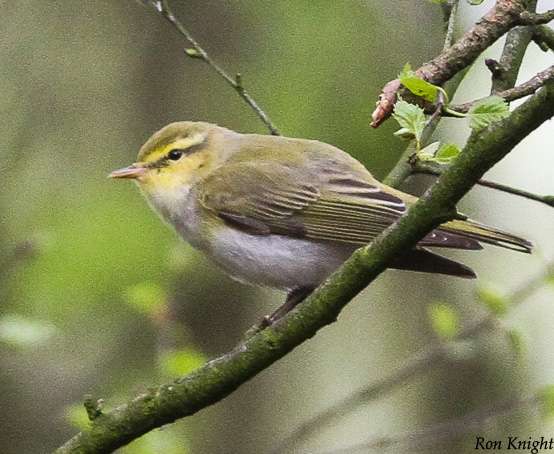
ID Keys: Greenish upperparts, pale underparts, pale yellow breast,
yellowish face and eyebrow
The
Wood Warbler is a "leaf warbler" species of the Old World. They are found as
breeding birds throughout much of temperature Europe, into far western Asia,
while they overwinter in tropical Africa. In North America they are
known from multiple sightings on islands and coastlines of Alaska.
Habitat
Found in deciduous woodlands and forests
Diet
Feeds on insects and spiders. They
will also sometimes feed on fruits and berries.
Behavior
Actively forages by hobbing and flitting
through foliage, either in the forest canopy or closer to the ground.
They feed by either gleaning insects directly from vegetation, or by
capturing insects in short flights.
Nesting
The nest of a Wood Warbler is placed on
the ground, or close to the ground in a shrub. It is a dome-shaped
structure with a side entrance, built of grasses, moss, rootlets, leaves,
and other vegetative material. The female lays between 5 and 7 eggs, and she
alone incubates them. The eggs hatch after about 13 days, and both
parents help to feed the young. Young fledge about 2 weeks after
hatching.
Song
The song is a high-pitched trilling that
continually increases in tempo. The trilling song is often followed by
a lower-pitchd series of 4 or 5 soft, monotonous notes.
Migration
Strongly migratory, Wood Warblers breed
in Europe and far western Asia, but move to tropical portions of Africa for
the winter.
In their Old World range, may be confused with other Phylloscopus
(leaf warbler) species. They are the largest of the Phylloscopus
species seen in their normal range in Europe.