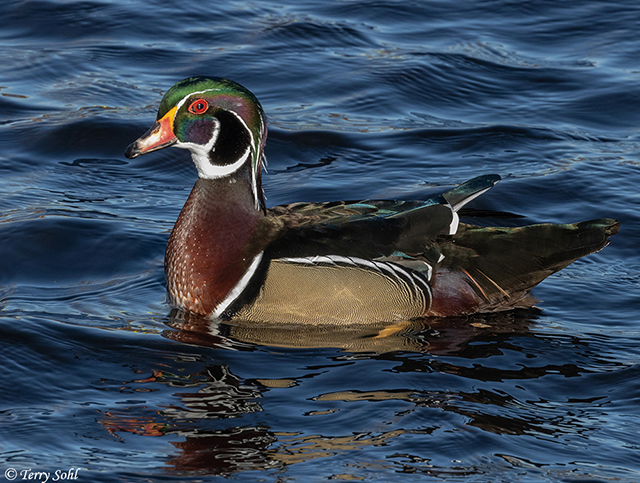
Wood Ducks are probably the most colorful duck found in the state. Unlike most duck species, they nest in trees. With heavy hunting pressure in the 19th century, and habitat destruction that decimated available nesting cavities, numbers plummeted by the early 20th century and Wood Ducks populations were in danger. They have been increasing in numbers in recent decades, helped greatly due to the huge numbers of nest boxes built especially for them. They are more common in the eastern half of the state.
Habitat
The Wood Duck inhabits wooded swamps, marshes, beaver ponds, oxbow lakes, slow-moving rivers, and forested wetlands with abundant trees nearby. It is closely associated with habitats that provide natural tree cavities or nest boxes for nesting and prefers calm waters with dense shoreline vegetation for cover and feeding.
Diet
The Wood Duck feeds on a wide variety of plant and animal foods, including acorns, seeds, fruits, aquatic vegetation, and agricultural grains. It also eats aquatic insects, snails, crayfish, and other small invertebrates, especially during the breeding season and while raising young.
Behavior
The Wood Duck is a secretive duck that often feeds in sheltered wetlands, flooded forests, and wooded shorelines rather than open water. It is highly agile in flight, maneuvering easily through trees, and is one of the few North American ducks that regularly perches in trees. During the breeding season, pairs often remain near nesting cavities, and newly hatched ducklings famously leap from the nest cavity to the ground or water shortly after hatching.
Nesting
April through June in South Dakota. Wood
Ducks are cavity nesters, unable to excavate their own cavity, so reliant on
natural tree cavities or those made by other species. They normally select a
cavity in a large tree, with the cavity anywhere from 3 to more than 50 feet
from the ground. While the nesting site is often close to water, it may be
up to a mile away from water if that's the only available nesting cavity.
The female lines the nesting cavity with down from her own body, and lays
between 5 and 15 eggs. Incubation takes between 26 and 35 days. The young
leave the nest about a day after hatching and gather their own food,
although they are protected and tended by the mother. The young are able to
fly about 2 months after hatching.
Wood Ducks have benefited greatly by the placement of specially made nesting
boxes, enabling nesting in areas where natural tree cavities have become
scarce.
Song
The most commonly heard sound from a wood duck is the alarm call as they flush. That alarm call is a series of multiple, loud, multi-tone calls that rise in pitch. Males also have a much more subtle whistling call.
- Click here to hear the typical alarm call of a Wood Duck1
- Click here to hear the subtle whistled calls of a male Wood Duck2
- Click here to hear mixed calls (and loud alarm calls) of Wood Duck3
Migration
The Wood Duck breeds across much of the eastern and central United States and southern Canada, then migrates south in fall to winter in the southern United States, Mexico, and parts of the Atlantic and Gulf coasts. Many populations are short-distance migrants, and some birds remain year-round where open water and suitable habitat persist. Migration typically follows river valleys, wetlands, and wooded waterways that provide food and cover.
Interactive eBird map
Click here to access an interactive eBird map of Wood Duck sightings
Similar Species
Female similar to other female ducks
Birdhouses
Will use nest boxes built for Wood Ducks.
Conservation Status
In decline at the start of the 20th century, they've expanded in numbers and range, in large part due to the numbers of nest boxes created. They're common in many parts of their range, and are found over a broad geographic area. The IUCN considers the Wood Duck to be a species of "Least Concern".
Photo Information
November 15th, 2020 -- Yankton, South Dakota -- Terry L. Sohl
