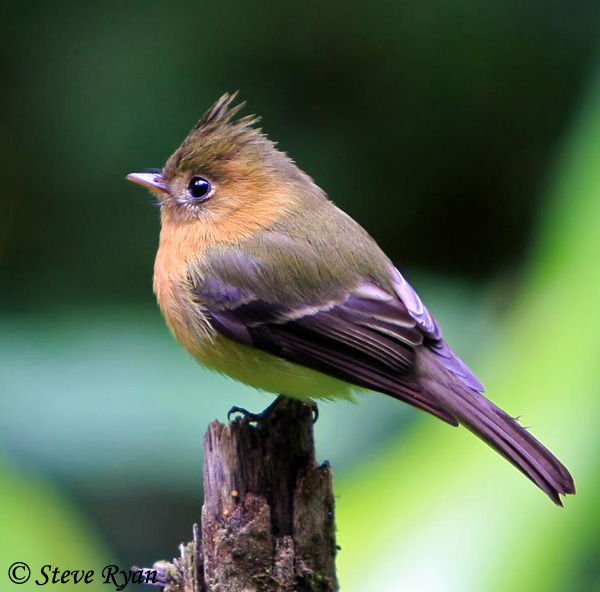
ID Keys: Olive-green upperparts, dark wings and tail, orangish face
and breast fading to more yellowish belly
The
Tufted Flycatcher is primarily a species of Mexico and Central America.
In the United States, they are known from a handful of sightings, with
multiple sightings in west Texas, in Big Bend National park, but also with
sightings in southern Arizona. With their rich coloring and the
obvious tuft, the Tufted Flycatcher is a rather easy to identify should it
be found in the United States.
Habitat
Found in forest areas, usually around
forest clearings and forest edges.
Diet
Feeds on insects
Behavior
Forages by observing from a perch,
flying out to capture insects in mid-air, or flying out and hovering briefly
while gleaning insects from foliage.
Nesting
The nest of a Tufted Flycatcher is a
shallow cup built of mosses, lichens, and other material. The female
usually lays 2 eggs, and she alone incubates them. When the eggs
hatch, both parents help tend to the young and feed them.
Song
Song of a Tufted Flycatcher is a very fast,
high-pitched bip-bip-bip-dididiup-bip-bip-bibibiseeeer.
Migration
Considered a permanent resident
throughout most of their range. Short-distance migrations do occur for
some populations, particularly those found at high elevations during the
summer.
Unique coloring in combination with the tufted appearance make the Tufted
Flycatcher a rather distinctive bird compared to other small birds that
might be encountered in Texas or Arizona (the two locations they've been
seen in the United States).