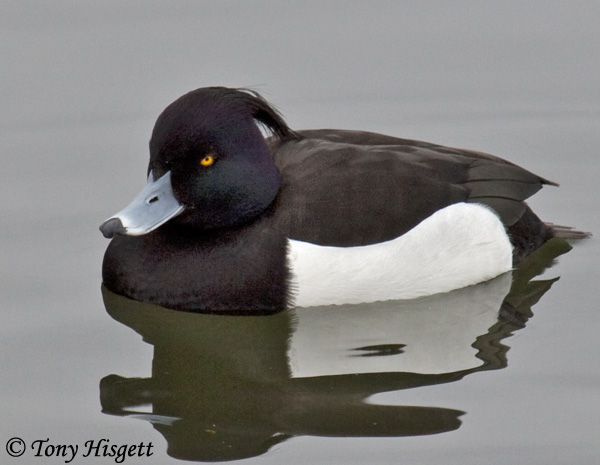
ID Keys: Males with obvious long tuft at back of head, otherwise
breeding adult males are dark with white flanks and belly.
Females similar in structure but brown overall, grayish-brown flanks
and belly.
The
Tufted Duck is a common diving duck of the Eastern Hemisphere, living
throughout much of Eurasia. They are winter vagrants in North America,
where they are most often found in Alaska, but they can also occasionally be
found along northern parts of both the Pacific and Atlantic Coasts of North
America. They are often considered the Old World's ecological equivalent to
North America's Ring-necked Duck, to
which they are closely related.
Habitat
During the summer breeding season, Tufted
Ducks are found in and around shallow water, freshwater lakes and ponds,
typically those with significant herbaceous vegetation around them margins.
They often prefer to nest on islands in these habitats. They can be
found in a wider variety of aquatic habitats in migration and in their
winter range.
Diet
Tufted Ducks will feed on a variety of
items, including clams and other mollusks, snails, aquatic insects and their
larvae, roots, tubers, and other parts of aquatic vegetation, and
occasionally small fish. On their winter range, they will also utilize
waste grain in agricultural fields.
Nesting
The nest of a Tufted Duck consists of
vegetation, either on the shoreline of islands, vegetation along the
shoreline of a lake, or on floating mats of vegetation.
Behavior
Strong swimmers, most of the
foraging is done by diving and swimming underwater. They will also
sometimes behave like dabbling ducks.
Song
The male has a fast whistled hooting when
courting females. Females have a soft growing.
Migration
The Tufted Duck breeds in much of the
northern portion of Europe and Asia. They migrate to more temperate
locations in Europe and Asia for the winter.