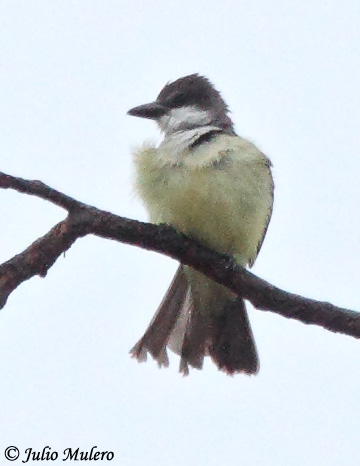
ID Keys: Dark gray upperparts, white below, large thick bill, pale
yellow underparts on juvenile
The
Thick-billed Kingbird is a large flycatcher species with a range mostly in
Mexico. They were unknown in the United States until the late 1950s,
when they started appearing in southern Arizona and New Mexico. They
have evidently been expanding their summer range to the north, and are now
found regularly in select locations in Arizona and New Mexico.
Habitat
In the United States portion of their
range, Thick-billed Kingbirds are most often found in forested riparian
areas, particularly in areas of cottonwoods and sycamore trees. In the
Mexican part of their range, they are found in a variety of open woodlands
and woodland edges.
Diet
Feeds on insects and spiders.
Behavior
Forages by observing from a perch and
flying out to capture insects in mid-air. They will also occasionally
glean insects from vegetation foliage and branches.
Nesting
The nest of a Thick-billed Kingbird is a
large cup of sticks, grasses, leaves, weed stems, and leaves. The
female usually lays 3 or 4 eggs, and she alone incubates them. When
the eggs hatch, both parents help to feed the young.
Song
Song of a Thick-billed Kingbird is a
metallic buzzing and clicking.
Migration
Considered a permanent resident in much
of their Mexican range, those found in the southwestern United States are
just summer breeding residents. Some wandering birds have overwintered
in California or parts of the Southwest.
Thick-billed Kingbird has mostly white underparts and a thick bill that
distinguish it from other kingbird species found in the same area.
Juvenile Thick-billed Kingbirds have a pale yellow belly, and may possibly
be confused with the other kingbirds in the region with yellow bellies (Cassin's
Kingbird, Tropical Kingbird).