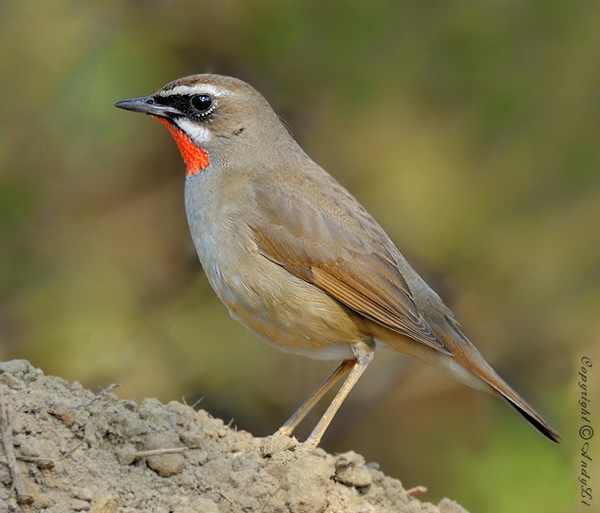
ID Keys: Tan and brown body. Males with obvious red throat, white
eyebrow and mustache. Females with pale throat.
The
Siberian Rubythroat is a ground-loving songbird of Asia. They
primarily breed in Siberia, while wintering in southern and southeastern
Asia. While very similar in overall appearance to thrushes, they may
more properly be classified as Old World flycatchers, and are now often
placed in the family Muscicapidae instead of the thrush family Turdidae.
They have occasionally wandered outside of their normal breeding and
wintering range, particularly in Eurasia where they have been found as far
west as Great Britain on occasion. In North America, they are
primarily known from several sightings on islands off the coast of Alaska.
However, one very lost bird was found in December of 1983 near Toronto,
Canada.
Habitat
Found in brushy forest clearings, edge of
taiga or boreal forest, shrubby streamside thickets, or other similar
semi-open habitats with available brush.
Diet
Feeds heavily on insects, spiders, worms,
and other small invertebrates, but will also eat berries and fruits.
Behavior
Feeding typically occurs on the ground
or low in vegetation such as in shrubs and streamside thickets.
Nesting
The nest of a Siberian Rubythroat is
placed on the ground in a protected area such as the base of a tree or
shrub, constructed of grasses, leaves, moss, hair, and other material.
The female lays 4 to 6 eggs and she alone incubates them. The eggs hatch
after about 2 weeks, and both parents help feed and raise the young.
Song
The song of a Siberian Rubythroat is a long
series of warblng notes. Calls include a loud chee-wah and a
lower-pitched kuck.
Migration
Migratory. During the summer they
are found as breeding birds in Siberia. They move to eastern India,
Thailand, Indonesia, and other nearby countries for the winter.
Feeders
Siberian Rubythroats will
occasionally attend feeders for offered fruits.