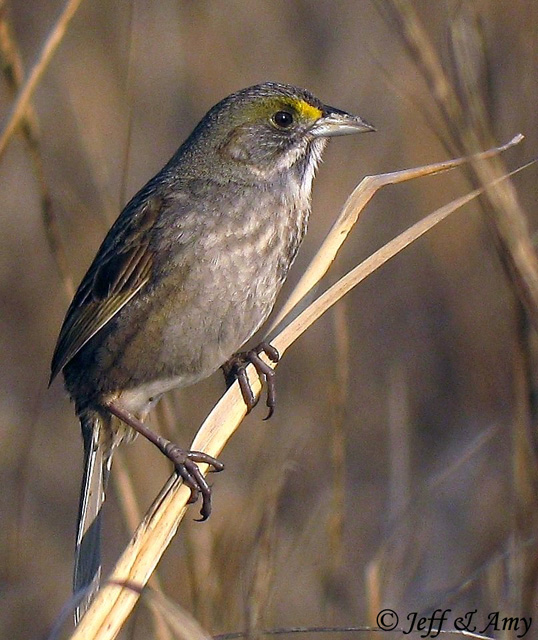
ID Keys: Grayish overall with yellow lores, streaks on back, white
throat, long bill. Gulf Coast, Sable, and Atlantic populations
differ in plumage characteristics.
The
Seaside Sparrow is an aptly named sparrow species found in tidal marsh areas
along the Gulf and Atlantic coasts of the United States. Habitats of
the species are disjunct, with scattered pockets in suitable habitat.
Separation of individual populations have led to multiple local races of
Seaside Sparrow, each with unique plumage and voice characteristics.
One of these, the "Dusky Seaside Sparrow", formerly found in Florida, is
presumed extinct. The "Cape Sable" Seaside Sparrow is found in
southern Florida, and has much whiter underparts than the other races, with
very obvious dark streaking. The "Gulf Coast" race has very distinct
streaks on its back, and a buffy breast with strong streaking. The
"Atlantic" race is duller and more gray overall, with streaking that is less
noticeable (see photo to the right for an Atlantic race Seaside Sparrow).
Habitat
Found in tidal salt marshes near the
coast, usually in areas with dense, tall vegetation growth.
Diet
Feeds on insects, spiders, and seeds, as
well as other invertebrates along the coast such as tiny craps, snails, and
marine worms. Seeds make up a large portion of the diet during the
winter months.
Behavior
Forages by moving along the ground or in
low vegetation growth, probing for insects and other prey creatures.
Nesting
The nest of a Seaside Sparrow is a cup
built of grasses, placed in low vegetation near the shoreline. The
female usually lays 3 or 4 eggs, and she alone incubates them. After
the eggs hatch, both parents help to feed the young, who leave the nest
after about 10 days. In some parts of their range, they may raise more
than one brood in a given year.
Song
Song of a Seaside Sparrow is short and
relatively quiet, consisting of three phrases ending in a buzzing note.
Migration
Many birds are permanent residents.
However, birds in the northern part of the range do move southward in
winter, and birds are found further south in Florida and Texas in winter.