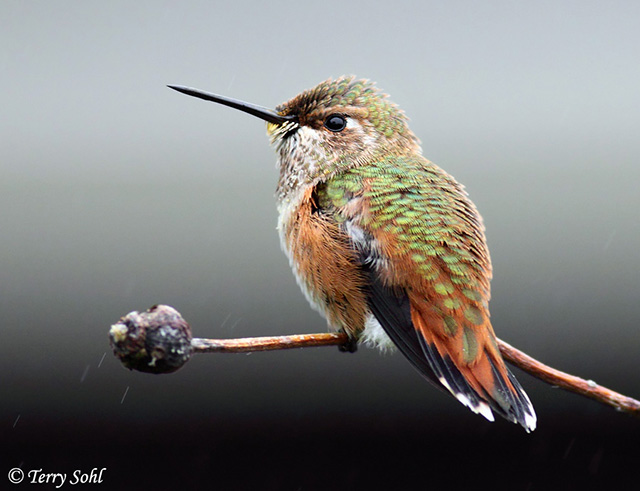
One of the most widespread breeders of the North American hummingbirds, they can be found in summer from southern Alaska down through the northwestern United States. Very aggressive, they often will dominate other hummingbirds, and will even chase away larger birds and small rodents away from their preferred feeding locations. Of all the western hummingbirds, the Rufous is the one most likely to wander far to the east during migration, and every year, a few are reported wintering in the southeastern United States.
Habitat
Breeds around forest edges and clearing, both near the coast and in the western mountains of the U.S. and Canada. They can be found in nearly any habitat during migration.
Diet
Feeds primarily on nectar. Also will feed on tiny insects, and will drink sap from holes created by sapsuckers.
Breeding
Non-breeder in South Dakota. On their breeding grounds, Rufous Hummingbirds will build their nest in either a conifer or deciduous tree, placed on a well protected/hidden horizontal branch, from 5 to 30 feet from the ground. The female builds the nest, constructing a small cup of plant down and spiders webs, camouflaged on the outside with lichens and bits of moss. She lays two eggs, and she alone incubates them. The young hatch after 14-16 days, and fledge from the nest after another 14-16 days.
Song
Vocalizations of a Rufous Hummingbird include a musical chip and repeated buzzy chattering. A buzzy trilling is also given off from males in flight, particularly when they make their J-shaped courtship flights.
- Click here to hear the unique sounds of the wings of a courting male Rufous Hummingbird1
- Click here to hear the chip calls of a female Rufous Hummingbird2
- Click here to hear the chase calls of a Rufous Hummingbird near a feeder3
Migration
Summers from the northwestern United States, through western Canada, and up to southern Alaska. Winters in southern Mexico. Rufous Hummingbirds are one western species that does occasionally wander widely, with eastern records occurring regularly. There are numerous records of wandering Rufous Hummingbirds in South Dakota, most from the Black Hills.
Interactive eBird Map
Click here to access an interactive eBird map of Rufous Hummingbird sightings
Similar Species
There are multiple hummingbird species that are found within the range of the Rufous Hummingbird that could cause identification challenges. Here are the species most likely to be confused with a Rufous Hummingbird, with identification keys:
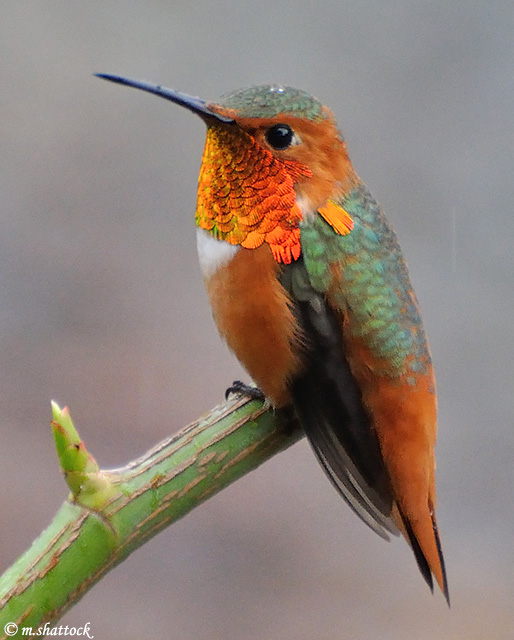
- Allen's Hummingbird - Differentiating between Allen's Hummingbirds and Rufous Hummingbirds is one of the most difficult identification challenges in North American birding. Range is one way to help identify species, as Allen's Hummingbirds are summer breeding birds in a thin strip along the California coast, wintering in central Mexico. Other hints on identification are often given, such as back color (there are claims a green-backed adult bird is an Allen's). More rigorous studies have suggested the only reliable way to differentiate between the two species is shape of the tail feathers, as the 2nd from the middle tail feather on a Rufous Hummingbird is "notched" on males, and "pinched" on females, while those shapes are not found on Allen's Hummingbirds.
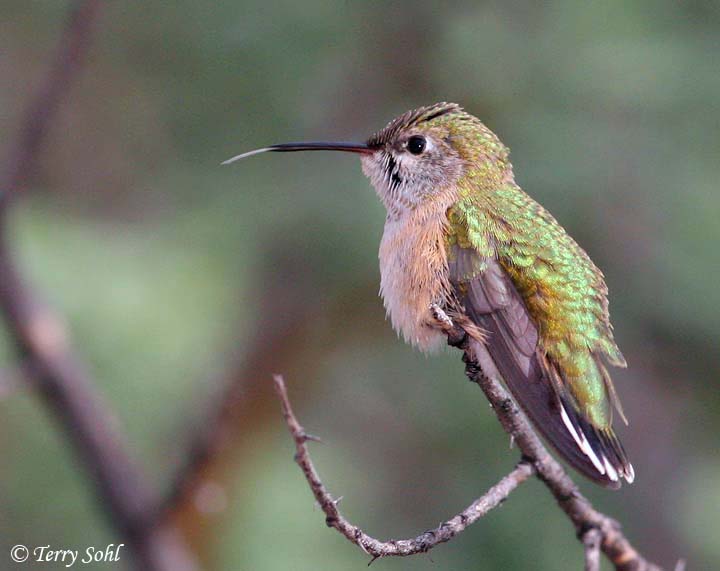
- Calliope Hummingbird - Female Calliope Hummingbirds could be confused with juvenile or female Allen's Hummingbirds. However, Calliope Hummingbird females have a consistent green coloring on their back and rump, while female and immature Rufous Hummingbirds typically have some coppery feathering towards the rump and tail. Calliope Hukmmingbirds are also smaller, but size can be difficult to judge unless the two species are side by side.
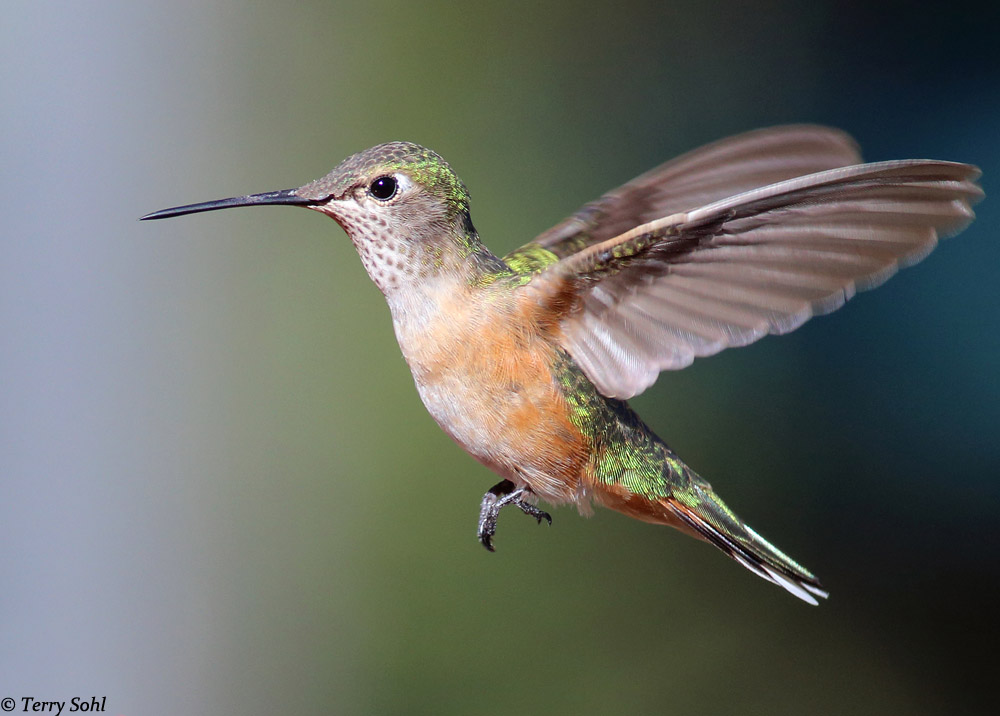
- Broad-tailed Hummingbird - Female Broad-tailed Hummingbirds can also be confused with juvenile or female Allen's Hummingbirds. Like Calliope Hummingbirds, female Broad-tailed Hummingbirds have a green rump, a differentiating feature from the coppery rump of a Rufous Hummingbird, but they may have some rusty feathering in the tail that confuses matters somewhat. Female Broad-tailed Hummingbirds also have a lighter, pale rusty color on the flanks compared to a Rufous Hummingbird.
 |
 |
 |
 |
| Allen's Hummingbird | Calliope Hummingbird | Broad-tailed Hummingbird | Broad-tailed Hummingbird |
Feeders
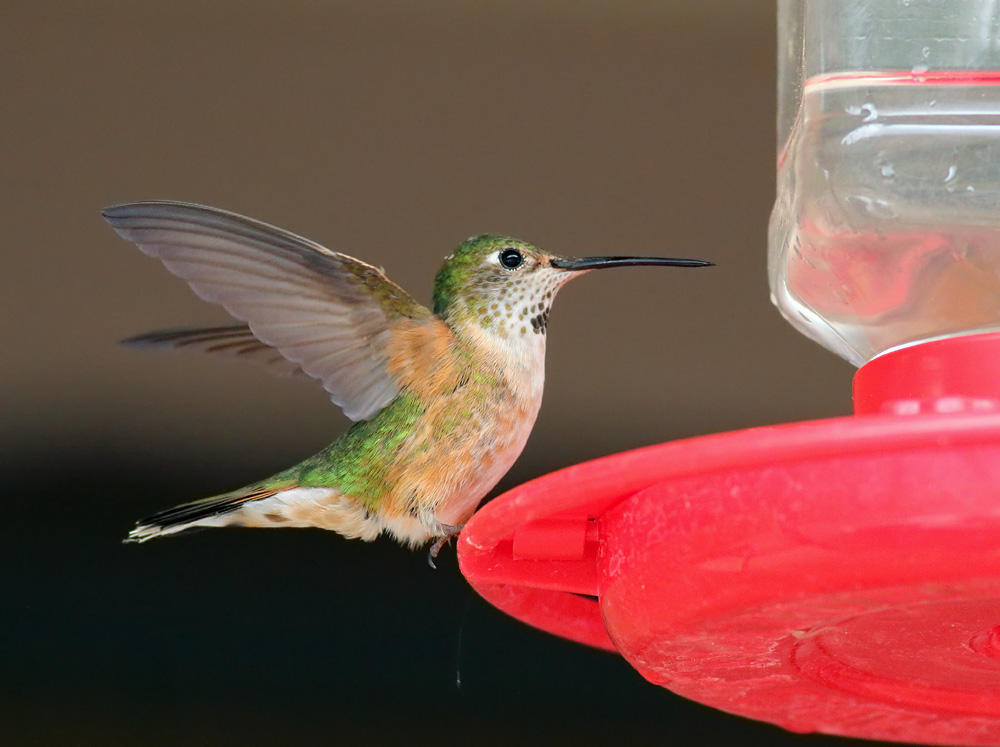
Will attend hummingbird feeders for sugar water.
Conservation Status
Systematic surveys consistently show population declines in recent decades, with the cause of the decline not fully understood. While they are found across a broad geographic area and are still relatively common in parts of that area, in 2018, the IUCN considered threats to the species to be substantial enough to list the Rufous Hummingbird as a "Near Threatened" species.
Photo Information
August 6th, 2013 - Cannon Beach, Oregon -- Terry Sohl
Audio File Credits
- 1Peter Ward and Ken Hall. Recorded in Campbell Valley Regional Park in British Columbia, Canada on May 10th, 1987. Original recording and information available from xeno-canto.
- 2Sue Riffe. Recorded in Boulder County, Colorado on August 4th, 2020. Original recording and information available from xeno-canto.
- 3Richard E. Webster. Recorded in Portal, Arizona on August 21st, 2012. Original recording and information available from xeno-canto.
