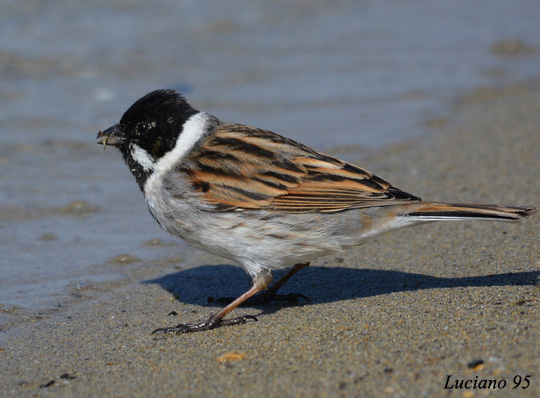
ID Keys: Male: Black head/throat, white collar, streaked back
The
Reed Bunting is a Eurasian species found in wetlands and marshes. In
North America, they are extremely rare vagrants, having only been found in
the far western Aleutian Islands of Alaska. While still primarily a bird of
marshy areas with thick vegetation, they have adapted to a human presence
and are now often found in anthropogenic landscapes such as agricultural
land and gardens, particularly in migration and in winter.
Habitat
During the breeding season, Reed Buntings are found in wetland areas with thick vegetation. Similar habitat may be used outside of the breeding season, but they will also use brushy thickets, agricultural land, and suburban areas with thick cover.
Diet
Mostly feeds on seeds, except during the breeding season when insects make up a large part of the diet.
Behavior
Gregarious outside of the breeding season, often forming mixed flocks with other Emberiza species.
Nesting
The nest is built on the ground in a protected area such as under a clump of vegetation. It is built of grasses and moss, lined with finer grasses, feathers, or animal hair. The female lays between 3 and 6 eggs, and she alone incubates them. The young hatch after about 2 weeks, and both parents help feed and tend to the young.
Song
The song of a Reed Bunting is a strong, precise s hree-shree-keree-tiktiktik.
Migration
Considered a permanent resident in some southern parts of its breeding range. However, most birds that breed in parts of northern Europe and northern Asia are migratory, moving to southern Europe, northern Africa, or southern Asia for the winter.
Feeders
Will readily attend feeders for millet, peanuts, safflower, and suet.
Interactive eBird map
Click here to access an interactive eBird map of Reed Bunting sightings
Similar Species
Distinctive if seen well. If any sightings were to occur in North America, most likely to be confused with Harris's Sparrow or Black-throated Sparrow . Also similar to Palla's Bunting and Rustic Bunting , species not normally found in North America.
Conservation Status
Populations are thought to be decreasing overall, but the Reed Bunting is still found over a very wide geographic area and populations are strong. The IUCN lists the Reed Bunting as a species of "Least Concern".
Photo Information
Photo taken by " Luciano 95 " - Photo licensed under Creative Commons Attribution 2.0 Generic License .