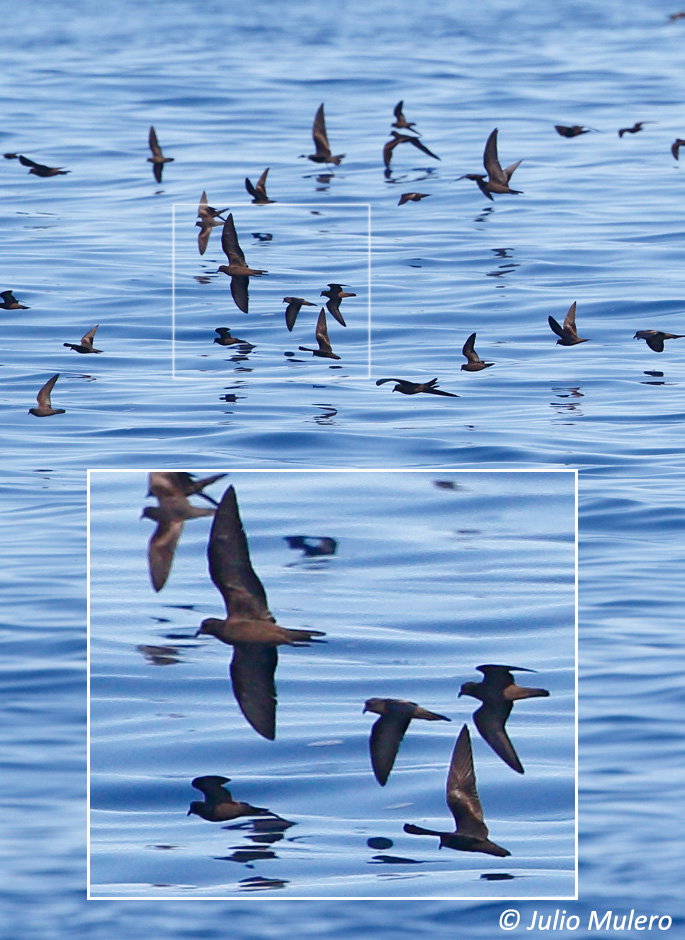
The Least Storm-Petrel is the smallest seabird in the world, measuring only about 5 inches (13 cm) in length. It is an oceanic species of the eastern tropical Pacific, spending nearly its entire life far from land over warm marine waters. The bird feeds on tiny crustaceans, fish larvae, and other planktonic organisms picked from the ocean surface while pattering across the water. It nests in burrows and rock crevices on isolated islands, returning to colonies only under cover of darkness. Despite its tiny size, it is a remarkably strong flier capable of ranging widely across open ocean habitats.
Habitat
The Least Storm-Petrel inhabits warm tropical and subtropical waters of the eastern Pacific Ocean, typically far offshore over deep marine environments. It comes to land only to breed, nesting on remote islands where it uses rock crevices, burrows, and protected cavities in arid coastal habitats. For most of the year, it remains entirely pelagic, rarely approaching shore.
Diet
The Least Storm-Petrel feeds primarily on tiny planktonic crustaceans, fish larvae, small squid, and other minute marine organisms gathered from the ocean surface. It often forages by fluttering low over the water and pattering its feet on the surface while picking prey from floating debris, slicks, and areas where food is concentrated.
Behavior
The Least Storm-Petrel spends nearly its entire life at sea, rarely approaching land except to breed. It forages by fluttering low over the water with quick, bat-like wingbeats, often pattering its feet on the surface while picking tiny prey from the ocean. Like many storm-petrels, it is primarily nocturnal at breeding colonies, returning to nesting sites under cover of darkness to avoid predators. Its small size and buoyant flight make it surprisingly difficult to observe even where it is common offshore.
Nesting
The Least Storm-Petrel nests in burrows, rock crevices, lava tubes, and other protected cavities on remote islands in the eastern Pacific. Breeding birds typically return to colonies only at night, reducing the risk of predation by gulls and other predators. The female usually lays a single white egg, and both parents share incubation duties and care for the chick until it fledges.
Interactive eBird Map
Click to access interactive eBird map for Least Storm-Petrel
Song
The Least Storm-Petrel is generally silent at sea but becomes vocal at breeding colonies at night. Its calls consist of soft chattering, trills, purrs, and high-pitched twittering notes used for mate recognition and communication in the darkness of nesting burrows and rock crevices.
Migration
The Least Storm-Petrel is not known for long-distance seasonal migrations like many seabirds. Most populations remain within the eastern tropical Pacific year-round, dispersing over offshore waters after breeding but generally staying within the same broad oceanic region. These movements are influenced more by ocean conditions and food availability than by a regular north-south migration pattern.
Similar Species
Black Storm-Petrel: The Least Storm-Petrel is dramatically smaller, with a shorter wingspan, shorter tail, and more delicate, bat-like flight. Black Storm-Petrels are much larger, longer-winged, and appear heavier-bodied with a more powerful flight style.
Wedge-rumped Storm-Petrel: Least Storm-Petrels have a short square tail and a very compact appearance, whereas Wedge-rumped Storm-Petrels show a noticeably wedge-shaped tail and a slightly larger, longer-winged profile. Wedge-rumped Storm-Petrels also tend to appear more elongated in flight.
Leach's Storm-Petrel: Leach's Storm-Petrels are much larger and show a conspicuous white rump patch that the all-dark Least Storm-Petrel lacks. Their flight is more bounding and shearwater-like, while Least Storm-Petrels exhibit rapid fluttering wingbeats close to the water.
Band-rumped Storm-Petrel: Band-rumped Storm-Petrels are substantially larger and show a bright white rump contrasting with dark upperparts. Least Storm-Petrels are tiny, entirely dark, and lack any obvious white rump marking.
Conservation Status
The Least Storm-Petrel is generally considered a species of low global conservation concern because of its broad distribution in the eastern tropical Pacific and large overall population. However, breeding colonies on islands can be vulnerable to introduced predators such as rats and cats, habitat disturbance, and changes in marine food availability. Continued protection of nesting islands and surrounding marine ecosystems is important for maintaining healthy populations of this tiny seabird. The IUCN lists the Least Storm-Petrel as a species of "Least Concern".
Further Information
- eBird - Least Storm-Petrel
- Audubon Field Guide - Least Storm-Petrel
- Cornell All About Birds - Least Storm-Petrel
Photo Information
Photo by Julio Mulero - October 11th, 2015 - Pelagic trip from San Diego, California.
