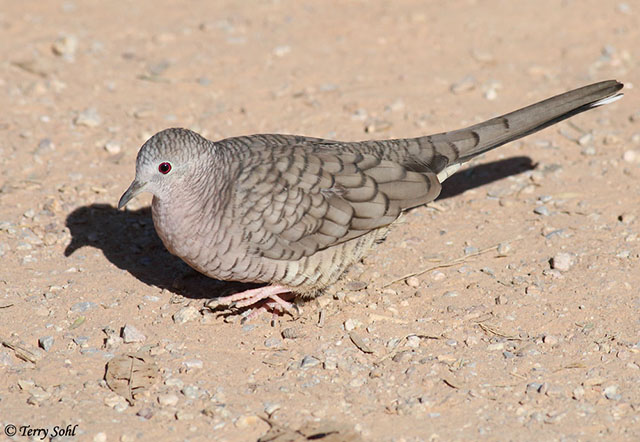
ID Keys: Scaled feather pattern, long tail, rusty red wing feathers
when flying.
The Inca Dove is primarily
associated with urban areas of the southwest U.S., as they've learned to take
advantage of the free handouts often provided by humans. In the U.S. part of
their range, they are actually quite uncommon outside of urban settings.
It is doubtful that they occurred in the United States before human settlement,
and their range is continuing to expand to the north.
Habitat
The Inca Dove inhabits arid and semi-arid environments, including desert scrub, thorn forests, brushy woodlands, riparian corridors, agricultural areas, parks, gardens, and suburban neighborhoods. It is especially common around towns and farms where scattered trees, shrubs, and human structures provide nesting sites and cover. The species readily adapts to urban environments throughout the southwestern United States, Mexico, and Central America.
Diet
The Inca Dove feeds primarily on small seeds from grasses, weeds, and cultivated plants. It also consumes grains, berries, and occasionally small insects. The species readily forages beneath bird feeders, where it eats spilled millet, cracked corn, sunflower seeds, and other small seeds.
Behavior
The Inca Dove is a small, ground-foraging dove that is usually seen alone, in pairs, or in small flocks. It spends much of its time walking quietly beneath shrubs or across open ground searching for seeds and readily visits backyard feeders. During cool weather, Inca Doves often huddle closely together in rows while roosting to conserve body heat. They are generally tame around people and have adapted well to urban and suburban environments.
Breeding
Non-breeder in South Dakota. The Inca Dove builds a small, flimsy platform nest of twigs, grasses, rootlets, and leaves, usually placed in a shrub, tree, cactus, vine, or on a building ledge or other man-made structure. The female typically lays 2 white eggs, and both parents share incubation and care of the young. In warm climates, Inca Doves often raise several broods each year, and pairs may reuse or refurbish old nests for successive nesting attempts.
Song
The Inca Dove gives a soft, mournful series of repeated cooing notes . Males call persistently from exposed perches during the breeding season to advertise territories and attract mates. The species also produces quiet contact calls and soft wing whistles during takeoff and flight.
Migration
The Inca Dove is primarily a nonmigratory species that remains within its home range throughout the year. Individuals may make short local movements in response to food availability or severe weather, but they do not undertake regular long-distance migrations. In recent decades, the species has gradually expanded its range northward in parts of the southwestern United States, aided by urban development and backyard bird feeders.
Common Ground Dove. The Inca Dove is larger and longer-tailed than the Common Ground Dove, with a distinctive scaly pattern over the neck, breast, and back. Common Ground Doves are much smaller and more compact, with a short tail, plain buffy underparts, and scattered black spots on the wings rather than an overall scaly appearance. Inca Doves also have a longer, graduated tail with white outer edges that is often flicked while perched, whereas Common Ground Doves have a much shorter tail and a more rounded silhouette.
Conservation Status
The Inca Dove is classified as Least Concern by the International Union for Conservation of Nature because of its large population, broad distribution, and increasing range in parts of North America. The species has adapted exceptionally well to urban and suburban environments, where ornamental plantings, buildings, and backyard feeders provide abundant food and nesting opportunities. Although localized habitat changes may affect some populations, it is not currently considered globally threatened.
Bird Feeders
Will attend feeders for various seeds.
Photo Information
December 28th, 2018 - Gilbert Water
Ranch in Phoenix, Arizona
- Terry Sohl