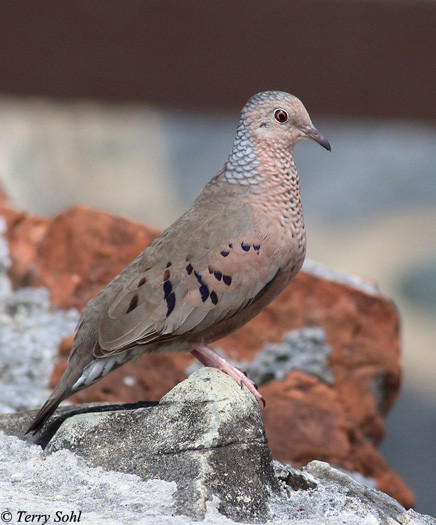
The Common Ground-Dove is one of the smallest doves in North America, recognized by its compact size, short tail, and warm brown plumage finely patterned with dark spots. It inhabits open fields, scrublands, brushy pastures, roadsides, agricultural areas, and suburban landscapes with scattered vegetation. Most of its diet consists of small seeds gathered while walking on the ground, although it also consumes some insects. The species is generally nonmigratory across much of the southern United States, Mexico, Central America, and the Caribbean, though some northern populations make short seasonal movements. Its soft, mournful cooing and habit of quietly foraging on the ground often make it more easily heard than seen.
Habitat
The Common Ground-Dove inhabits open and semi-open landscapes such as brushy fields, scrublands, desert edges, grasslands, agricultural areas, roadsides, coastal thickets, parks, and suburban neighborhoods. It favors habitats with sparse vegetation and patches of bare ground where it can forage for seeds while remaining close to shrubs, low trees, or other cover for protection.
Diet
The Common Ground-Dove feeds primarily on small seeds from grasses, weeds, sedges, and other herbaceous plants. It forages almost entirely on the ground, picking up seeds from bare soil, roadsides, fields, and open areas, and occasionally consumes small insects and other invertebrates.
Behavior
The Common Ground-Dove spends much of its time walking quietly on the ground while searching for seeds. It is usually seen singly, in pairs, or in small groups and often remains close to low shrubs or other cover, flushing only short distances when disturbed. Its flight is fast and direct, with rapid wingbeats and a tendency to quickly drop back into vegetation. Compared with many larger doves, it is generally inconspicuous and can be surprisingly easy to overlook.
Breeding
Non-breeder in South Dakota. In range, the Common Ground-Dove builds a small, flimsy platform nest of twigs, grasses, and rootlets, usually placed in a low shrub, small tree, cactus, vine tangle, or other dense vegetation. Nests are typically located only a few feet above the ground and are often well concealed. The usual clutch consists of 2 white eggs, and both parents share incubation duties and care for the young. Like many doves, the species may raise multiple broods during a single breeding season where conditions are favorable.
Song
The Common Ground-Dove gives a soft, mournful, repetitive coo often described as a low-pitched wooo-oo. The song is usually delivered from a low perch such as a fence wire, shrub, or small tree and can be surprisingly ventriloquial, making the bird difficult to locate. Calls also include quiet whistles and soft contact notes exchanged between mates and nearby birds.
Migration
The Common Ground-Dove is largely nonmigratory throughout most of its range, remaining year-round across the southern United States, Mexico, Central America, the Caribbean, and much of northern South America. Northern populations along the edge of the range may make short-distance seasonal movements southward during colder weather, but the species does not undertake the long-distance migrations typical of many songbirds. Overall, it is considered a resident bird with only limited local or regional movements.
Similar Species
Inca Dove: The Common Ground-Dove is smaller and more compact than the Inca Dove, with a shorter tail and a plainer appearance. Inca Doves show a noticeably long tail and a distinctive scaly pattern over much of the body, giving them a more textured look.
Ruddy Ground-Dove: Male Ruddy Ground-Doves are rich cinnamon-rufous overall with a contrasting gray head, making them much more colorful than the brownish Common Ground-Dove. Female Ruddy Ground-Doves are more similar, but they generally appear warmer brown and less finely spotted than the Common Ground-Dove, which shows a characteristic scaled and spotted pattern on the wings and upperparts.
Feeders
Will come for seeds scattered on the ground.
Conservation Status
The Common Ground-Dove is considered a species of low conservation concern, with a large population and extensive range across the southern United States, Mexico, Central America, the Caribbean, and parts of South America. The species adapts well to a variety of open and semi-open habitats, including agricultural areas, scrublands, and suburban environments. Although local populations may be affected by habitat changes, the overall population is considered stable, and the species remains widespread and common throughout much of its range. The IUCN conciders the Common Ground Dove to be a species of "least concern".
Photo Information
June 2015 - St. John's, U.S. Virgin Islands - Terry Sohl
Interactive eBird Map
Click to access the interactive eBird species sightings page for Common Ground-Dove
