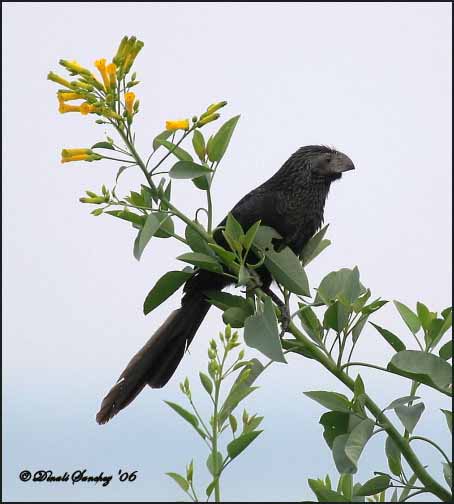
The Groove-billed Ani is a distinctive, long-tailed member of the cuckoo family found from the southern United States through Mexico and Central America. It inhabits open grasslands, agricultural fields, brushy pastures, scrub, and woodland edges, where it forages for insects, lizards, fruits, and other small prey. Groove-billed Anis are highly social birds, often traveling in noisy groups and cooperating to defend territories and raise young. Multiple females frequently lay eggs in a single communal nest, with several adults sharing incubation and care of the chicks. In North America, the species is a localized resident in southern Texas and a regular visitor to southeastern Arizona, with occasional wanderers appearing farther north. Its glossy black plumage, deep grooved bill, and gregarious behavior make it one of the most distinctive birds of the Southwest.
Habitat
The Groove-billed Ani inhabits open grasslands, brushy pastures, agricultural fields, scrublands, woodland edges, riparian thickets, and semi-open country. It prefers areas with scattered shrubs, dense hedgerows, or low trees that provide cover for nesting and roosting while allowing access to open feeding areas. The species readily occupies ranchlands, roadsides, and other human-modified landscapes throughout much of its range.
Diet
The Groove-billed Ani feeds primarily on insects, including grasshoppers, beetles, caterpillars, crickets, and other large arthropods. It also consumes spiders, small lizards, frogs, fruits, berries, and occasionally seeds.
Behavior
The Groove-billed Ani is a highly social bird that typically travels and forages in small family groups. It often follows livestock to catch insects flushed from the grass and spends much of its time walking or hopping on the ground rather than flying. During the breeding season, several pairs may cooperate by building a communal nest, sharing incubation duties, and jointly caring for the young.
Breeding
Non-breeder in South Dakota. In range, the Groove-billed Ani is well known for its cooperative breeding behavior. Several females often lay their eggs in a single large cup-shaped nest built of twigs and lined with leaves, usually placed in a dense shrub or small tree. Multiple adults share incubation and the feeding and protection of the chicks, making the species one of the few North American birds that regularly nests communally.
Song
The Groove-billed Ani gives a variety of harsh, nasal calls, including grating croaks, squeaks, whistles, and chattering notes. Family groups remain in frequent contact with these vocalizations while foraging and moving through brushy habitats. The species is especially noisy around communal nests, where adults use a range of calls to communicate and defend the nesting area.
Migration
The Groove-billed Ani is primarily a resident species throughout most of its range. Northern populations, including those in southern Texas and southeastern Arizona, may make short-distance seasonal movements southward during winter or in response to cold weather. Overall, it is not considered a long-distance migratory species, and many birds remain near their breeding areas year-round.
Interactive eBird Map
Click here to access an interactive eBird map of Groove-billed Ani sightings
Similar Species
Smooth-billed Ani. The Groove-billed Ani is distinguished by the prominent deep grooves running along the upper bill, a feature lacking in the Smooth-billed Ani, whose bill is relatively smooth and more evenly rounded. Groove-billed Anis also tend to have a slightly smaller, more compact appearance and occur primarily from the southwestern United States through Mexico and Central America, whereas Smooth-billed Anis are found mainly in the Caribbean, South America, and southern Florida.
Conservation Status
Generally stable through the U.S. portion of its range. Forest clearing in the tropical part of its range have resulted in increased numbers, due to their habitat preferences.
Further Information
- eBird - Groove-billed Ani
- Audubon Field Guide - Groove-billed Ani
- Cornell Lab of Ornithology - All About Birds: Groove-billed Ani
Photo Information
Photo - By Didi Sanchez
