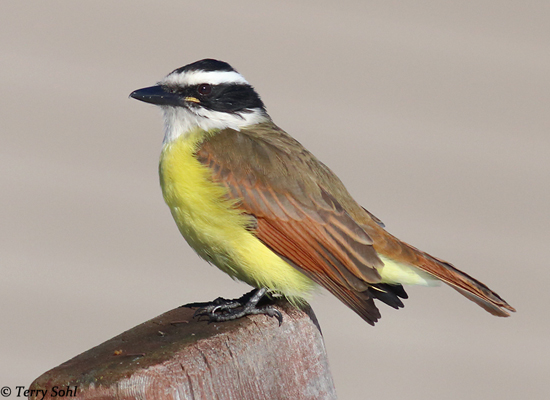
The Great Kiskadee is a tropical flycatcher, quite dissimilar in appearance to other flycatchers typically found in the United States. It differs not only in looks, but also in behavior. In addition to flying out from a perch to grab insects (ala most flycatchers), the Great Kiskadee also acts like a shrike at times, pouncing on lizards or other small vertebrates, and will even fish like a kingfisher. This adaptable and opportunistic bird is a common sight throughout Latin America. The species is named after it's loud calls. In South Dakota, they were an unknown species until 2015, listed as "hypothetical" based on an unconfirmed sighting of one in the state. Given that no surrounding states had any sightings of the bird, further sightings of the bird were clearly not expected. However, in the fall of 2015, at least one and possibly up to three different Great Kiskadees were found at a farmstead near Volga, South Dakota. At least one bird survived into December.
Habitat
Can occur in most habitats with trees, but is often found in woodlands or other trees near streams and poinds. They typically need both trees and open lands, and avoid dense forest.
Diet
Will feed on a wide variety of items, both vegetable and animal matter. Often feeds on large insects, but will also take fish, lizards, tadpoles, small mice, baby birds, and eggs. Also feeds on fruits and berries.
Behavior
The Great Kiskadee is a bold, aggressive, and highly adaptable bird that readily occupies urban areas, woodlands, wetlands, and forest edges. It typically hunts from exposed perches, making quick flights to capture insects, small fish, frogs, and other prey, while also feeding on fruit. Great Kiskadees vigorously defend their territories and are well known for chasing away much larger birds, including hawks and other predators.
Nesting
The Great Kiskadee builds a large, bulky, dome-shaped nest of twigs, grasses, rootlets, and other plant material, usually placed in a tree, shrub, or occasionally on a man-made structure. The enclosed nest has a side entrance that helps protect the eggs and young. The female typically lays 2–4 cream-colored eggs marked with reddish-brown spots, and both parents share incubation and care of the nestlings.
Song
The Great Kiskadee is famous for its loud, ringing call that sounds like its name: kis-ka-dee! These emphatic calls are given throughout the day to defend territories, communicate with mates, and maintain contact with family members. The species also produces a variety of whistles, chatter, and harsh scolding calls during social interactions and when confronting predators.
Migration
The Great Kiskadee is primarily a resident species throughout most of its range, remaining in the same area year-round. Some populations at the northern edge of the range may make short seasonal movements in response to weather or food availability, but the species is not considered a long-distance migrant. Its adaptability to a wide variety of habitats allows it to maintain permanent territories across much of the Americas.
Interactive eBird Map
Click here to access an interactive eBird map of Great Kiskadee sightings
Similar Species
Distinctive in the United States, but several other tropical flycatchers are similar in appearance.
Conservation Status
The Great Kiskadee is classified as Least Concern by the International Union for Conservation of Nature because of its extremely large range and abundant, stable population. It remains common across much of Central and South America, Mexico, and the Lower Rio Grande Valley of Texas, where it readily adapts to both natural and human-modified habitats. No major population declines have been identified that would currently place the species at significant conservation risk.
Further Information
- eBird - Great Kiskadee
- Audubon Field Guide - Great Kiskadee
- Cornell Lab of Ornithology - All About Birds: Great Kiskadee
Photo Information
December 2nd, 2015 - Near Volga in South Dakota - Terry Sohl
