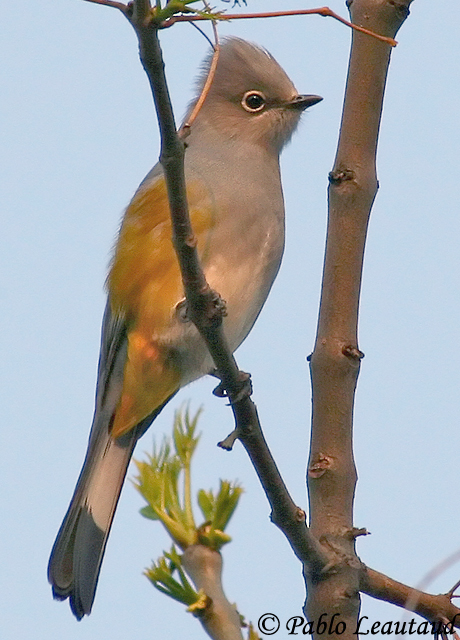
The Gray Silky-Flycatcher is a relative of the Phainopepla, the rather unusual bird found in the American Southwest. The Gray Silky-Flycatcher, however, is only a very rare vagrant to the United States, with a handful of sightings in southern Texas, as well as in California. They are normally found in Mexico, with a range that also extends just into northern Guatemala. Much like the Phainopepla, Gray Silky-Flycatchers feed heavily on berries, and can often be found in small foraging groups in areas with heavy berry crops. Those found in the United States have been stray individuals, however.
Habitat
The Gray Silky-flycatcher inhabits montane pine-oak forests, cloud forests, woodland edges, and highland clearings of Mexico and Central America. It is most commonly found in cool, moist mountain habitats, often between 4,000 and 10,000 feet (1,200–3,000 m) in elevation. The species also occurs in parks, orchards, and other lightly wooded areas where fruiting trees and shrubs are abundant.
Diet
The Gray Silky-flycatcher feeds primarily on small fruits and berries . It also consumes insects, catching them in midair or gleaning them from foliage, particularly during the breeding season. The species often forages in the forest canopy or at woodland edges, sometimes in small groups.
Behavior
The Gray Silky-flycatcher is an active and social bird that often forages in pairs or small flocks, sometimes joining mixed-species feeding groups. It moves through the canopy and woodland edges searching for fruit and insects, frequently making short aerial sallies to capture flying prey. During the breeding season, pairs defend territories around nesting sites but otherwise remain tolerant of other individuals where food is abundant.
Nesting
Builds a cup-shaped nest, and the female lays 2 eggs. The female alone incubates the eggs. When the eggs hatch, both parents help tend to and feed the young, who leave the nest after about 25 days.
Song
The Gray Silky-flycatcher gives a variety of soft, high-pitched whistles, thin trills, and musical calls that carry well through montane forests. Males sing pleasant, warbling phrases during the breeding season to defend territories and attract mates. Flocks also maintain contact with quiet, tinkling calls while moving through the canopy in search of fruit and insects.
Migration
The Gray Silky-flycatcher is primarily a resident species throughout the mountains of Mexico and Central America. Most individuals remain within the same general region year-round, although some populations make short elevational movements, descending to lower elevations during the nonbreeding season in response to food availability. It is not considered a long-distance migratory species.
Interactive eBird Map
Click here to access an interactive map of Gray Silky Flycatcher sightings
Similar Species
Phainopepla. The Gray Silky-flycatcher is larger and mostly soft gray with a long crest, yellow eyes, and bright yellow wing patches, whereas the Phainopepla is glossy black (male) or plain gray (female) with striking red eyes and conspicuous white wing patches visible in flight. Gray Silky-flycatchers are birds of cool montane forests in Mexico and Central America, while Phainopeplas are primarily found in desert washes, oak woodlands, and open habitats of the southwestern United States and Mexico.
Conservation Status
Populations are large, spread over a large geographic region, and are considered relatively stable. The IUCN lists the Gray Silky-Flycatcher as a species of "Least Concern".
Further Information
- eBird - Gray Silky-Flycatcher
- Audubon Field Guide - Gray Silky-Flycatcher
- Cornell Lab of Ornithology - All About Birds: Gray Silky-Flycatcher
Photo Information
Photo taken by Pablo Leautaud - December 11th, 2007 - San Angel Inn, Villa Obergon, DF, Mexico - Photo licensed under Creative Commons Attribution NonCommercial 2.0 Generic License.
