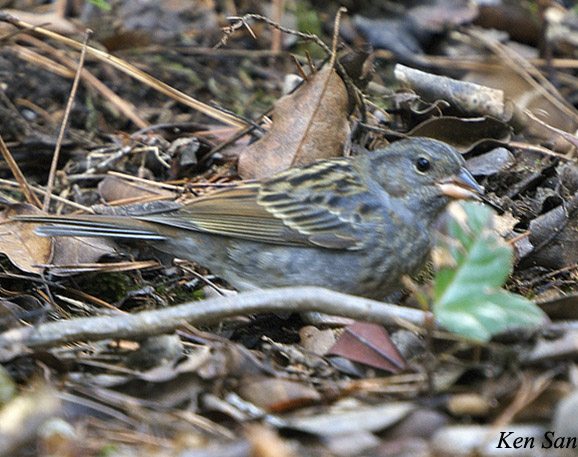
The Gray Bunting is normally found in the Kamchatka peninsula of Russia and in Japan. In North America, they are only known from a handful of sightings in the far western Aleutian Islands.
Habitat
Found in forested and shrubby habitats, including mixed deciduous and coniferous forests, shrubby woodlands, and bamboo forests. Often found in areas with significant topographic relief. In winter they are often found in marsh reedbeds or riparian zones.
Diet
Feeds heavily on seeds, but will also take insects, fruits, and berries. Consumption of insects is primarily limited to the breeding season.
Behavior
Often feeds on the ground, but will also feed in the foliage of bushes and trees.
Nesting
The nest of a Gray Bunting is a cup of grasses, moss, and leaves, with a lining of softer grasses and rootlets. The nest usually is constructed on the ground in a protected area such as under a tussock of grass, or is placed low in a bush or small tree. The female lays between 3 and 6 eggs, and she alone incubates them. The eggs hatch after about 12 days, and both parents feed them until they fledge after about 2 weeks.
Song
The song of a Gray Bunting is a repetitive series of the same, harsh note.
Migration
Summers on the Kamchatka peninsula of Russia and in northern Japan. Populations are migratory, with birds wintering in the southern half of Japan.
Interactive eBird map
Click here to access an interactive eBird map of Gray Bunting sightings
Feeders
Will readily attend feeders for millet, peanuts, suet, and fruits.
Similar Species
Most likely to be confused with Black-faced Bunting or Little Bunting in range (species not found in North America).
Conservation Status
Populations are considered stable, and they're found over a relatively large geographic area. The IUCN lists the Gray Bunting as a species of "Least Concern".
Further Information
- eBird - Gray Bunting
- Audubon Field Guide - Gray Bunting
- Cornell Lab of Ornithology - All About Birds: Gray Bunting
2) W hatbird.org - Gray Bunting
3) H andBook of Birds of the World - Gray Bunting
Photo Information
Photo by "Ken" - Photo licensed under Creative Commons Attribution NonCommercial ShareAlike 2.0 Generic License.
