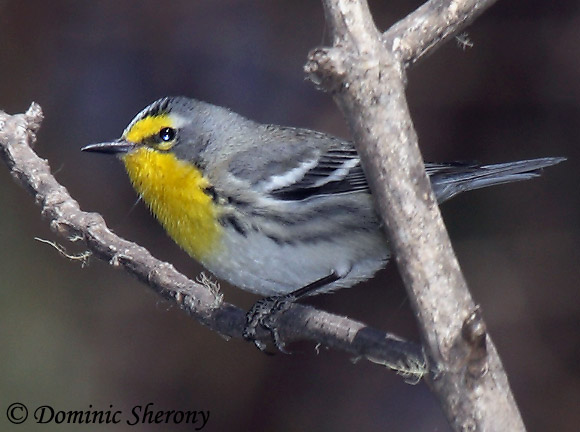
The Grace's Warbler is a small, active songbird that breeds in pine forests of the southwestern United States and Mexico. It is recognized by its bright yellow face and throat, gray upperparts, white wing bars, and slender bill adapted for catching insects. Unlike many warblers, Grace's Warbler spends much of its time high in the canopy, where it gleans insects and spiders from pine needles and branches. It nests in coniferous forests, building a small cup nest on horizontal pine limbs. Most populations migrate to Mexico and Central America for the winter, although some birds remain in Mexico year-round. In North America, the species is strongly associated with mature pine woodlands and is considered an important indicator of healthy conifer forest ecosystems.. The species was named after the sister of 1800s ornithologist Elliott Coues, who first described the species in 1864.
Habitat
During the summer breeding season, Grace's Warblers are found in forested habitats, usually pine but also sometimes in other evergreens or in mixed evergreen/deciduous forest. During the winter, they are found in mountain pine/oak forests of Mexico.
Diet
The Grace's Warbler feeds primarily on insects and other small arthropods, including caterpillars, beetles, spiders, flies, and leafhoppers. It forages high in pine trees, carefully gleaning prey from needles, cones, and small branches. Unlike many other warblers, it rarely feeds on the ground and only occasionally supplements its diet with small berries or other plant material.
Behavior
Spends most of its time high in the forest canopy. Grace's Warblers forage by "flycatching" (flying out from a perch to grab flying insects), clambering on tree branches and foliage, or hovering and gleaning insects from plants. .
Nesting
The Grace's Warbler builds a small, well-concealed cup nest of grasses, bark strips, moss, lichens, and spider silk, usually placed on a horizontal branch high in a pine tree. The female typically lays 3–5 white eggs marked with brown or reddish spots and performs most of the incubation. Both parents help feed the nestlings until they fledge.
Song
The Grace's Warbler gives a thin, high-pitched, buzzy song consisting of a rapid series of short notes that accelerate slightly toward the end. Males sing frequently from the tops of pine trees during the breeding season to defend territories and attract mates. The species also produces sharp tsip calls used for contact and alarm.
Migration
The Grace's Warbler is a migratory species in the northern part of its range. Birds breeding in the southwestern United States migrate south to Mexico and parts of Central America for the winter, while many populations in Mexico remain year-round residents. Migration occurs primarily at night, with birds returning to breeding areas in spring to nest in mature pine forests.
Interactive eBird map
Click here to access an interactive eBird map of Grace's Warbler sightings
Similar Species
Yellow-throated Warbler, Magnolia Warbler , Yellow-rumped Warbler.
Compared with Yellow-throated Warbler: The Grace's Warbler has a bright yellow face and throat with plain gray upperparts, while the Yellow-throated Warbler has a bold black-and-white facial pattern, a bright yellow throat, and conspicuous white eyebrow. Yellow-throated Warblers also have heavier streaking on the sides and are more often associated with hardwoods, cypress swamps, and mixed forests.
Compared with Magnolia Warbler: The Grace's Warbler lacks the bold black necklace, heavily streaked yellow underparts, and broad white tail patches of the Magnolia Warbler. Grace's Warbler is also much plainer overall and spends most of its time high in pine canopies.
Compared with Yellow-rumped Warbler: The Grace's Warbler lacks the bright yellow rump, yellow side patches, and streaked breast of the Yellow-rumped Warbler. Grace's Warbler has a cleaner gray-and-yellow appearance and is closely associated with pine forests, whereas Yellow-rumped Warblers occupy a much wider variety of habitats.
Conservation Status
The Grace's Warbler is classified as Least Concern by the International Union for Conservation of Nature because of its relatively large range and stable overall population. Although the species depends on mature pine forests and may be affected locally by logging, severe wildfires, and habitat degradation, it remains fairly common throughout much of its range and is not currently considered globally threatened.
Further Information
- eBird - Grace's Warbler
- Audubon Field Guide - Grace's Warbler
- .Cornell Lab of Ornithology - All About Birds: Grace's Warbler
Photo Information
February 14th, 2009 - Jalisco, Mexico - Photo by Dominic Sherony - Licensed under Creative Commons Attribution Share-Alike 2.0 Generic license.
