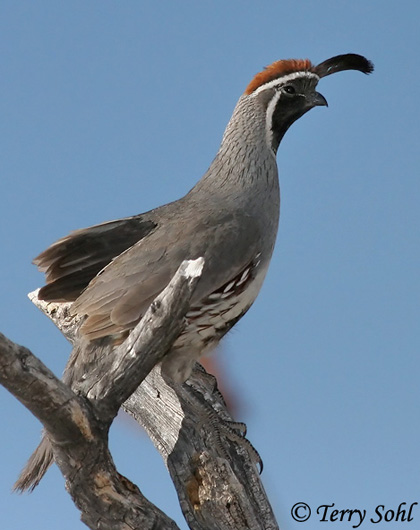
Gambel's Quail are the Sonoran desert equivalent of the closely related California Quail. The ranges of the two species do not overlap, but the plumages are quite similar, right down to the distinctive curved "topknot" feather (actually a plume of 6 individual feathers). Gambel's Quail inhabitat the dry shrubby habitats of the desert Southwest, where small coveys of the birds can often be seen scurrying across roads or through desert vegetation. The handsome birds have been introduced on some of the Hawaiin Islands.
Habitat
They have adapted very well to dry Sonoran desert environments, but the largest concentrations of Gambel's Quail are often found around riparian areas and sources of water. They can be found in different shrubby habitats, but seem to prefer true Sonoran desert habitat with scattered cactus and mesquite. They also have adapted to living in and around suburban areas, given that adequate vegetative cover is available.
Diet
Feeds mostly on vegetative material, includings seeds, fruits, nuts, leaves, and berries. They will occasionally eat insects, but typically not as much as California Quail.
Behavior
Gambel's Quail most often forage on the ground, but will also forage in shrubs and trees. They forage in coveys outside of the breeding season with coveys of 20-30 birds a typical size, but they may forage in pairs or smaller family groups after the young have fledged in the late spring. When disturbed, they prefer to quickly run into thick cover, only taking flight when absolutely necessary to avoid danger.
Nesting
The nest is a shallow depression lined with grasses and leaves, usually placed nest to the base of a shrub or other vegetation. Females alone incubate a nest of around a dozen eggs, but both parents will help to raise the young.
Song
The Gambel's Quail is a vocal species with a variety of distinctive calls used for communication, territorial defense, and maintaining contact within coveys. Its most familiar call is a loud, rhythmic cow-cow-cow, often given by males from elevated perches during the breeding season. The species also produces soft clucks, chirps, and assembly calls that help keep family groups together while foraging.
Migration
The Gambel's Quail is a nonmigratory species that remains within its home range throughout the year. Individuals may make short local movements in response to food availability, water, or seasonal weather conditions, but they do not undertake true migrations. Family groups, or coveys, stay together during much of the year and occupy relatively small territories.
Interactive eBird Map
Click here to access an interactive eBird map of Gambel's Quail sightings
Similar Species
California Quail most similar. Also similar to Mountain Quail .
Compared with California Quail: The Gambel's Quail has a plain buff-colored belly with a distinct black patch, while the California Quail has a heavily scaled belly and flanks. Gambel's Quail also has a chestnut crown and is most common in desert scrub, whereas California Quail is typically found in chaparral, oak woodlands, and coastal habitats.
Compared with Mountain Quail: The Gambel's Quail is smaller and has a short, forward-curving topknot, while the Mountain Quail has a much longer, straight head plume and a slimmer appearance. Mountain Quail also inhabits mountainous forests and dense brush, unlike the desert and riparian habitats favored by Gambel's Quail.
Feeders
Gambel's Quail will attend ground feeders for seed, or areas where seed is scattered on the ground.
Conservation Status
The Gambel's Quail is classified as Least Concern by the International Union for Conservation of Nature because of its wide distribution across the southwestern United States and northwestern Mexico and its large overall population. Although local numbers may fluctuate with drought, habitat changes, and hunting pressure, the species remains common throughout much of its range and is not considered globally threatened.
Further Information
- eBird - Gambel's Quail
- Audubon Field Guide - Gambel's Quail
- Cornell Lab of Ornithology - All About Birds: Gambel's Quail
Photo Information
May 10th, 2008 - Saguaro National Park, Arizona - Terry Sohl
