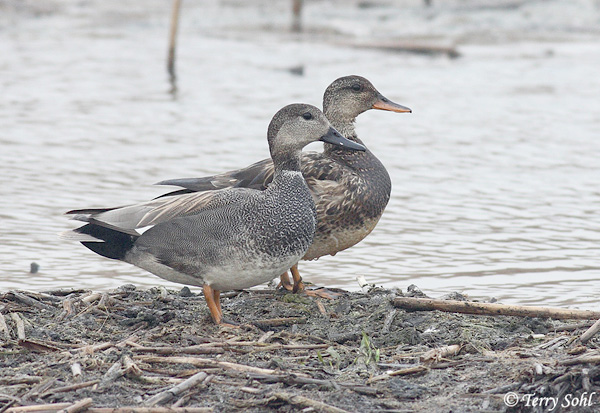
While a fairly common summer resident in South Dakota, the Gadwall is often overlooked due to its rather plain plumage. Even the male has a relatively drab plumage compared to most male dabbling ducks, in terms of color, but the plumage patterns on a gadwall are quite beautiful if seen well. Gadwalls can also be found throughout Europe and Asia.
Habitat
Prefers lakes and wetlands in open prairie areas, and can also be found in coastal marshlands.
Diet
Primarily feeds on aquatic plants. They will also feed on crustaceans, mollusks, insects and insect larvae, and occasionally small fish.
Behavior
Very rarely forages on land, nearly always forages on the water. Primarily acts like a dabbling duck, grabbing items from the water's surface or by upending and submerging it's head underwater. They are also capable of diving underwater in search of food.
Nesting
May through July
Song
Whiny meeep calls from the male. Typical quacking from female.
Migration
Summers throughout much of the Northern Plains and parts of the (lower-elevation) West. Winters along U.S. coastlines, the southern half of the U.S., and Mexico. Some birds in the Western and Southern U.S. may be permanent residents.
Interactive eBird Map
Click here to access an interactive eBird map of Gadwall sightings
Similar Species
Mallard
Conservation Status
Its normal breeding range in the Northern Plains is smaller than that of many other ducks, and thus it was probably affected more by human settlement and alteration of the region than were many other species. Current populations are probably stable, however.
Further Information
Photo Information
April 1st, 2012 - Dewey Gevik Nature Area near Sioux Falls, South Dakota - Terry Sohl
