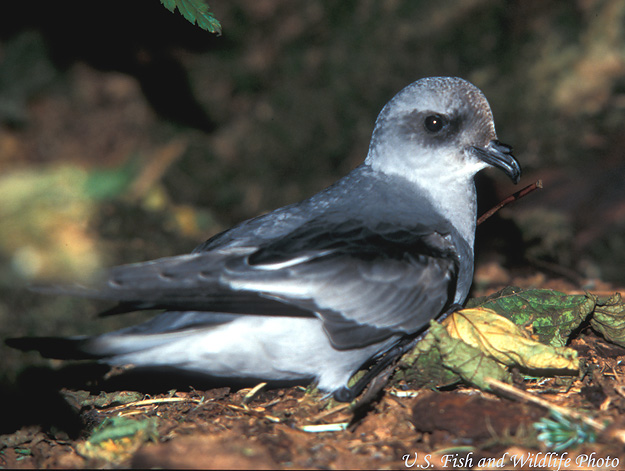
ID Keys: Silvery-gray plumage overall, forked tail, dark markings on
underwing coverts and parts of upper wings
The
Fork-tailed Storm-Petrel is readily distinguished from other Storm-Petrel
species, as it is the only Storm-Petrel that is gray overall, rather than
mostly black. They are common in the North Pacific, particularly
around Southern Alaska. Smaller numbers may be found as far south as
coastal Washington and Oregon, and in some winters, there are outbreaks of
Fork-tailed Storm-Petrels as far south as southern California.
Habitat
The Fork-tailed Storm-Petrel is a pelagic seabird that spends most of its life over cold offshore waters of the North Pacific Ocean. It breeds on remote coastal islands, nesting in rock crevices, burrows, and cavities on steep slopes, cliffs, and talus fields. Outside the breeding season, it ranges widely over open ocean waters, often far from land, where it forages over deep marine habitats.
Diet
Feeds mostly on small fish and crustaceans. They will also sometimes feed on carrion, and will skim oily residues from the water's surface that are left by whale or other large marine mammal carcasses.
Behavior
Forages by taking food form the surface of the water, mostly by hovering over the ocean's surface and plucking food items with its bill. They will also sometimes swim on the ocean's surface and pick up food items while swimming.
Nesting
The Fork-tailed Storm-Petrel excavates a burrow in soft soil, or uses natural cavities such as crevices in rocks, or burrows built by other animal species. The nest itself may consists of a small amount of grass or other vegetative material, or no formal nest may be constructed. The female lays a single egg, which is incubated by both the male and female. Once the young hatches, both parents feed it, with the young typically fledging from the nest at about 2 months of age.
Song
At breeding locations, adults have a mellow trilling sound, as well as harsher, high-pitched notes. They are usually silent away from their nest site.
Migration
Not truly migratory, as birds are present over their breeding range at all times of the year. However, variable numbers of Fork-tailed Storm-Petrels move further southward along the U.S. West Coast in the winter, with birds sometimes reaching as far south as southern California.