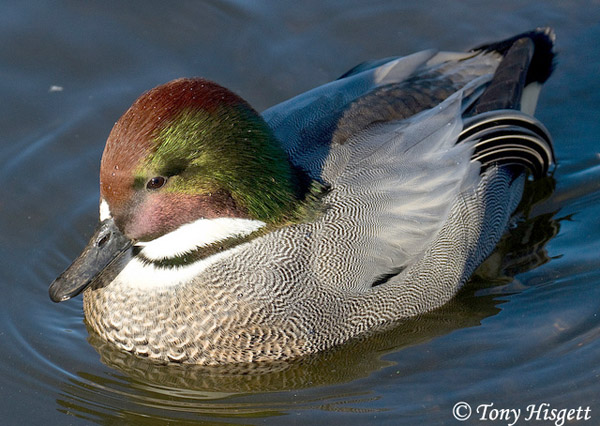
ID Keys: Male distinctive with green and rust colored head, white
throat, finely barred body plumage, sickle-shaped feathers covering
rear flanks
The
Falcated Duck, also known as the Falcated Teal, is a dabbling duck normally
found in eastern Asia. However, vagrants have been found in North
America on rare occasions, with individual birds spotted in the Aleutian
Islands and in scattered locations near the west coast of the United States.
The species is listed as "near-threatened" by the IUCN. Hunting of the
species on its wintering ground in China is cited as a primary reason for
declines in the species (IUCN).
Habitat
During the summer breeding season, found in wetlands and wetland margins around water bodies such as lowland lakes and ponds. They use similar habitat in winter, but can also occasionally be found in saltwater estuaries and lagoons.
Diet
The Falcated Duck feeds primarily on aquatic vegetation, including seeds, leaves, stems, and roots of wetland plants. It also consumes small aquatic invertebrates such as insects, crustaceans, and mollusks, particularly during the breeding season.
Behavior
The Falcated Duck is a generally social species that often forms pairs during the breeding season and gathers in flocks during migration and winter. Like other dabbling ducks, it feeds primarily by tipping forward in shallow water rather than diving. It is typically wary and quiet, spending much of its time resting, preening, and foraging in wetlands, lakes, flooded fields, and sheltered coastal waters.
Song
The Falcated Duck is generally a quiet species, especially outside the breeding season. Males produce soft, whistling calls and low musical notes during courtship, while females give a series of harsher quacks similar to those of many dabbling ducks. Most vocal activity occurs during pair formation and breeding.
Migration
The Falcated Duck is a migratory species that breeds in eastern Siberia, Mongolia, northeastern China, and adjacent regions of Asia. It winters primarily in eastern and southeastern Asia, including China, Korea, Japan, and parts of Southeast Asia. Migration occurs along major East Asian flyways, with birds traveling between northern breeding wetlands and more temperate wintering areas.
Distinctive plumage if seen well, most similar to Green-winged Teal. The Falcated Duck is noticeably larger than the Green-winged Teal and has a long, elegant profile with distinctive elongated, sickle-shaped tertial feathers on the male. Male Falcated Ducks also show an iridescent green head and silvery-gray body, whereas male Green-winged Teal have a chestnut head with a bold green eye patch and lack the long falcate feathers.
Conservation Status
The Falcated Duck is classified as Least Concern by the International Union for Conservation of Nature because of its large geographic range and substantial overall population. However, some regional populations face pressures from wetland loss, habitat degradation, and hunting. Despite these threats, the species remains sufficiently widespread and numerous that it is not currently considered globally threatened.
Photo Information
Photo taken by Tony Hisgett - Licensed under Creative Commons Attribution 2.0 Generic License