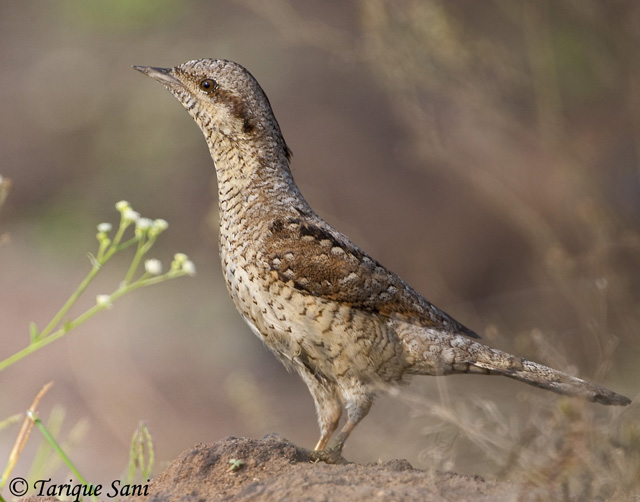
ID Keys: Tannish-gray overall with buffy and brown barring, dark eye
stripe, darker wings. Very well camouflaged.
The
Eurasian Wryneck is a very unusual member of the Woodpecker family, with a
normal range that spans across much of Europe and Asia. In North
America, they are known from a handful of sightings in extreme western
Alaska. Curiously,
in February of 2000, a dead Eurasian Wryneck was found in Indiana.
The source of the Indiana bird is in question, but it is possible it was a
natural lost migrant, given the species strong migratorial tendencies.
The term "Wryneck" refers to their capability to turn their heads 180
degrees, a capability they take advantage of when disturbed, as they will
turn their heads and hiss at threats.
Habitat
The Eurasian Wryneck inhabits open woodlands, orchards, forest edges, hedgerows, parks, and traditional agricultural landscapes with scattered trees. It favors areas that provide nesting cavities along with open ground where it can forage for ants and other insects. During migration and winter, it may also be found in scrublands, savannas, and lightly wooded habitats.
Diet
The Eurasian Wryneck feeds primarily on ants and their larvae and pupae, which it extracts from the ground using its long, sticky tongue. It also consumes other small insects and invertebrates when available. Most foraging takes place on the ground in grassy areas, open woodlands, orchards, and pastures.
Behavior
The Eurasian Wryneck is a secretive and well-camouflaged bird that often remains motionless against tree bark or among vegetation. Unlike most woodpeckers, it rarely drums on trees and spends much of its time foraging on the ground for ants. When threatened, it performs its characteristic defensive display by twisting and stretching its neck in a snake-like manner, giving rise to the name "wryneck."
Nesting
The Eurasian Wryneck nests in natural tree cavities, old woodpecker holes, nest boxes, and occasionally crevices in buildings. Unlike most woodpeckers, it does not excavate its own nesting cavity but instead relies on existing holes. The female typically lays 7–12 white eggs, and both parents share incubation duties and care for the nestlings.
Migration
The Eurasian Wryneck is a strongly migratory species throughout much of its range. Birds breeding in Europe and northern Asia migrate south to sub-Saharan Africa, southern Asia, and other warmer regions for the winter. Migration occurs mainly at night, with most birds departing breeding grounds in late summer and returning during spring.
Definitely unique compared to any other woodpecker species that has been seen in North America.
Conservation Status
The Eurasian Wryneck is classified as Least Concern by the International Union for Conservation of Nature because of its broad distribution across Europe, Asia, and Africa. However, populations have declined in parts of Europe due to habitat loss, agricultural intensification, and reductions in suitable nesting sites. Despite these regional declines, the species remains widespread enough that it is not currently considered globally threatened.
Photo Information
Photo taken by Tarique Sani - December 16th, 2009 - Nimji, Maharashtra, India - Photo licensed under Creative Commons Attribution NonCommerical ShareAlike 2.0 Generic License.