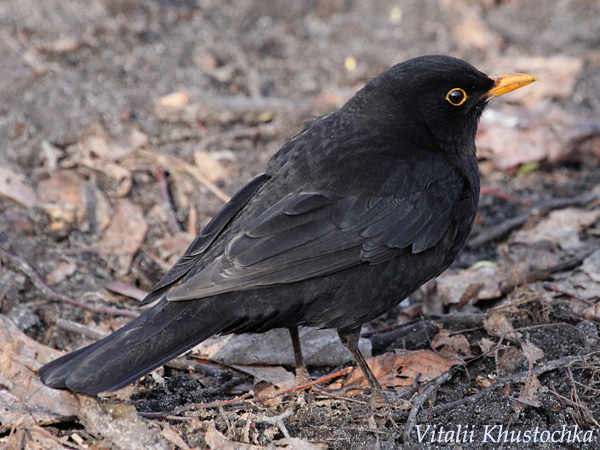
ID Keys: Males black with orange bill and eye-ring. Females
brownish overall with paler underparts, streaking.
The
Eurasian Blackbird, also known as the Common Blackbird in its native Europe
and Asia, is a common thrush with very basic black plumage, with a obvious
orange eye-ring and bill. They are found throughout most of Europe and
parts of southern Asia. In North America, they are known only from a
handful of sightings in southeastern Canada. There is some question as
to whether the birds sighted in North America were truly wild vagrants, or
if they were escapees from captivity. However, the species has
expanded its range in recent decades. Once very rare vagrants in
Iceland, they now regularly are found as breeding birds there, and vagrants
have also shown up in Greenland. As with several other species of European
songbirds, they have also been introduced in Australia and New Zealand, and
now have established populations throughout both countries.
Habitat
Found in a very wide variety of habitats including forests and woodlands, agricultural landscapes, and urban parks and suburbs.
Diet
Omnivorous, feeding heavily on insects and other small invertebrates such as earthworms, snails, and slugs. They will also feed on fruits and berries if available.
Behavior
Foraging often occurs on the ground, with birds walking and hopping about in search of insects and other invertebrates. They will also feed in the forest canopy or in shrubby vegetation when fruit is available.
Nesting
The female builds a nest of grasses, leaves, rootlets, and other vegetation, bound together with mud. The nest is usually placed in a dense thicket or bush, but as the species is well accustomed to a human presence, they will also sometime build the nest on a human structure. The female lays 2 to 5 eggs, and she alone incubates them. The young hatch after about 13 days, and are fed by both parents. The young leave the nest about 2 weeks after hatching. In many locations Eurasian Blackbird pairs will raise 2 or even 3 broods in a given year.
Song
The song is a series of warbled phrases that may vary between local populations. They also have a variety of calls.
Migration
Considered permanent residents in much of their range, particularly in western Europe and southern parts of their range. Eurasian populations further north typically do migrate southward or westward for the winter, with some birds overwitnering as far away as northern Africa or far southern reaches of Asia.
Interactive eBird map
Click here to access an interactive eBird map of Eurasian Blackbird sightings
Similar Species
Adult males that may be seen as vagrants in North America are unlikely to be confused with other species. The brownish females may be potentially confused with other native North American blackbird species.
Conservation Status
Eurasian Blackbird populations are strong overall, and may be increasing. They are found over a very broad geographic area, and are common in parts of their range. The IUCN lists the Eurasian Blackbird as a species of "Least Concern" .
Photo Information
Photo by Vitalii Khustochka - Photo licensed under Creative Commons Attribution Non-Commercial 2.0 Generic license.