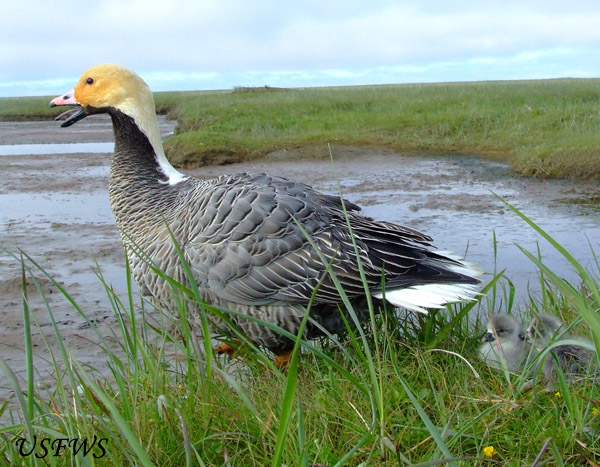
ID Keys: Gray overall, with white head and tail, small pink bill
The
Emperor Goose is a bird of the Bering Sea area, breeding in western Alaska
and parts of eastern Siberia, and wintering in the Aleutian Islands.
The species has always had a relatively small home range and has never been
common, but numbers declined sharply throughout much of the 20th century.
Populations have recovered slightly from 1980s lows, but the species still
remains vulnerable to disturbance and hunting.
Habitat
Found in and around salt water at all seasons. During the summer breeding season, they are found in marshy tundra in western Alaska, but never more than 10 or 15 miles from the coastline. In winter, they are found along shorelines.
Diet
During the summer breeding season, feeds mostly on grasses, sedges, roots, tubers, and fresh plant shoots. During the winter, they feed heavily on mussels and clams, as well as aquatic plants.
Nesting
Nest of the Emperor Goose is a shallow depression built on a shoreline of a tundra lake. The nest is constructed with a lining of grasses and sedges, finished with a heavy layer of down. The female alone incubates the eggs, but both parents tend to the young after hatching. Young leave the nest and find their own food within a day of hatching.
Song
Squeaky, high-pitched honking.
Migration
Migratory, but a short-distance migrant. Breeds in scattered locations in western Alaska. Wintering grounds are predominantly the Aleutian Islands. They also breed in Siberia. Stray birds have occasionally been sighted far down the Pacific Coast, with individual birds being found as far south as California in the fall.
Interactive eBird Map
Click here to access an interactive eBird map of Emperor Goose sightings
Similar Species
Snow Goose , Ross's Goose
Conservation Status
The IUCN lists the Emperor Goose as "Near Threatened ". Populations declined significantly throughout the 20th century. Subsistence hunting of the species, as well as pollution and oil extraction activity, are thought to have contributed to the decline. The species has recovered slightly since the 1980s, but remains threatened, especially given the likely negative impacts of climate change on this Arctic species.
Photo Information
Photo taken in Yukon National Wildlife Refuge - June 19th, 2007 - U.S. Fish and Wildlife (Public Domain)