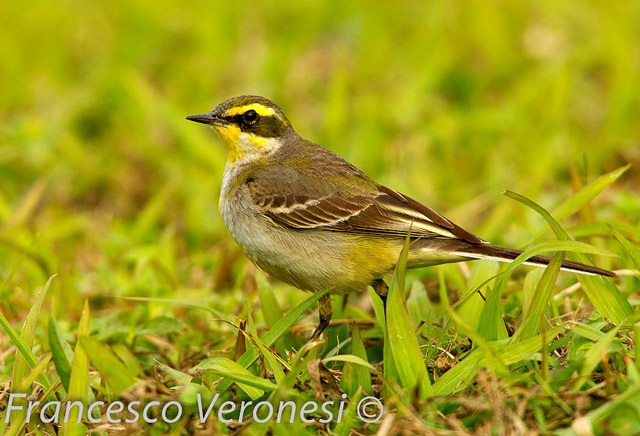
ID Keys: Yellow underparts, olive-gray upperparts, white eye stripe,
black cheeks on breeding male
The
Eastern Yellow Wagtail and the Western Yellow Wagtail (not found in North
America) were recently split from the former "Yellow Wagtail"
(Motacilla flava), although some authorities continue to maintain the old
classification of one Yellow Wagtail species. Most Eastern Yellow Wagtails
are found as breeding birds in northern Asia, but there are also breeding
birds in northern and western Alaska. Long-distance migrants, Eastern
Yellow Wagtails migrate to southeast Asia or the Australia region for the
winter. As with other wagtail species, Eastern Yellow Wagtails do indeed
frequently wag their tail as they walk along the ground, foraging for
insects and other food items.
Habitat
The Eastern Yellow Wagtail breeds in open Arctic and subarctic habitats, including tundra, wet meadows, marshes, river floodplains, coastal grasslands, and shrubby wetlands across northeastern Asia and Alaska. During migration and winter, it occupies a variety of open habitats such as agricultural fields, rice paddies, grasslands, mudflats, shorelines, marshes, and wet pastures. It is usually found near water or in areas with short vegetation where it can forage on the ground.
Diet
The Eastern Yellow Wagtail feeds primarily on insects and other small invertebrates. Its diet includes flies, mosquitoes, beetles, ants, caterpillars, spiders, and aquatic insect larvae, which it captures while walking and running across mudflats, grasslands, shorelines, and wet meadows. Small crustaceans and other tiny invertebrates may also be taken when available.
Behavior
Feeds by walking on the ground, often making fast runs to capture insects when they are spotted. They will also sometimes catch flying insects in flight, or hover briefly while gleaning insects from vegetation.
Nesting
The nest of an Eastern Yellow Wagtail is a cup of grasses, weeds, mosses, and lichens, lined with feathers or animal hair. The nest is built on the ground, usually under a small shrub or next to a clump of grass. The female usually lays 4 or 5 eggs, and both parents help to incubate them. When the eggs hatch, both parents help to raise the young. The young leave the nest after about 2 weeks.
Song
The Eastern Yellow Wagtail gives a sharp, high-pitched, repeated tseep call that is often heard as birds fly overhead. Its song is a pleasant series of thin trills, warbles, and twittering notes delivered from low perches or during display flights on the breeding grounds.
Migration
The Eastern Yellow Wagtail is a long-distance migrant that breeds across northeastern Asia and western Alaska. After breeding, it migrates south through eastern Asia to winter in Southeast Asia, Indonesia, the Philippines, New Guinea, and Australia. Birds breeding in Alaska cross the Pacific region during migration, making this one of the more remarkable migratory routes among Arctic passerines. In the continental United States, the species is a rare migrant and vagrant.
Coloration distinguishes it from other Wagtail species that have been found in North America.
Conservation Status
The Eastern Yellow Wagtail is generally considered a species of low conservation concern. It occupies a vast breeding range across northeastern Asia and Alaska and remains common in many tundra, wetland, and grassland habitats. Although local populations may be affected by habitat alteration, wetland degradation, and environmental changes on the breeding grounds, the species is currently regarded as widespread and secure overall. The IUCN lists the Yellow Wagtail as a species of "Least Concern".
Photo Information
Photo taken by Francesco Veronesi - January 7th, 2011 in Taiwan - Photo licensed under Creative Commons Attribution NonCommercial ShareAlike 2.0 Generic License