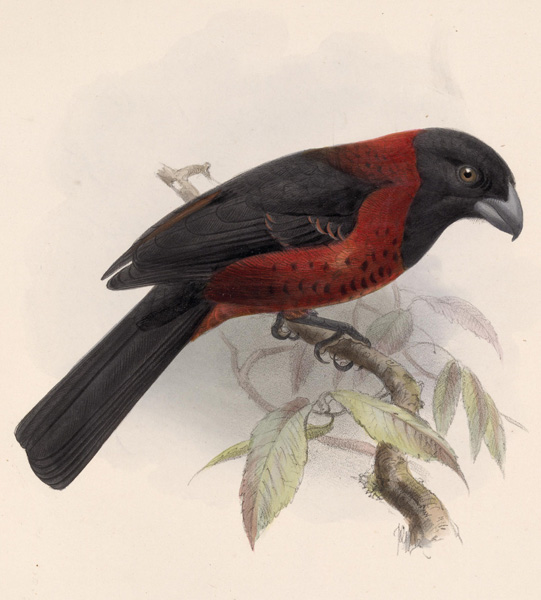
The Crimson-collared Grosbeak is a species with a very small geographic range in eastern Mexico. In the United States, they are rare visitors to southern Texas, where most birds have been seen during the winter months. The first sighting occurred in 1974, and several sightings have occurred since then. It is a little studied species, with much to be learned about habits, diet, and breeding behavior.
Habitat
The Crimson-collared Grosbeak inhabits tropical and subtropical forests, woodland edges, dense thickets, brushy clearings, second-growth forests, and riparian woodlands of eastern Mexico. It is most often found in humid lowland and foothill forests where dense vegetation provides abundant cover for feeding and nesting. The species typically remains hidden within thick foliage and is often easier to hear than to see.
Diet
Feeds on fruit, berries, leaves, and insects. Exact dietary preferences are uncertain . May feed heavily on the leaves of a particularly shrubby nightshade species .
Behavior
When feeding on leaves and fruits, may be quite sedentary while foraging, lingering in one location and periodically feeding.
Nesting
The Crimson-collared Grosbeak builds a cup-shaped nest of twigs, grasses, rootlets, and other plant materials, usually placed in a shrub, vine tangle, or small tree within dense vegetation. The nest is often well concealed by surrounding foliage. Although details of its breeding biology are not as thoroughly documented as those of many North American songbirds, both parents are believed to participate in raising the young.
Song
The Crimson-collared Grosbeak gives a rich, musical song composed of clear whistles, warbles, and melodious phrases that are often compared to those of other grosbeaks. Calls include sharp chips, metallic notes, and short contact calls exchanged between birds in dense vegetation.
Migration
Considered a permanent resident throughout its range. Birds seen in the U.S. have mostly been seen in the winter, so some short-distance movement after the breeding season may occur.
Similar Species
Distinctive if seen well. Most likely to be confused with the Black-headed Grosbeak. The Crimson-collared Grosbeak is much more boldly patterned than the Black-headed Grosbeak. Adult male Crimson-collared Grosbeaks are striking black birds with a vivid crimson-red collar, throat, and upper breast, whereas male Black-headed Grosbeaks have a black head, warm orange-cinnamon underparts, and prominent white wing patches. Females are also quite different. Female Black-headed Grosbeaks are heavily streaked brown with bold facial markings, while female Crimson-collared Grosbeaks are darker, more uniformly colored, and lack the strongly patterned face typical of female Black-headed Grosbeaks.
Conservation Status
The Crimson-collared Grosbeak is generally considered a species of low conservation concern. Although its range is restricted to eastern Mexico, it remains fairly widespread within suitable forest and woodland habitats and is not currently considered globally threatened. Habitat loss from deforestation and land conversion may affect some local populations, but the species is generally regarded as stable across much of its range. Despite the very small geographic range, populations are strong enough and stable that the IUCN lists the Crimson-collared Grosbeak as a species of "Least Concern".
Photo Information
Painting is public domain image, from "Biologia Central-Americana" by John Gerrard Keulemans (1842-1912). Image dates from 1902 publication.
Interactive eBird Map
Click to access the eBird integrated species sightings page for Crimson-collared Grosbeak
