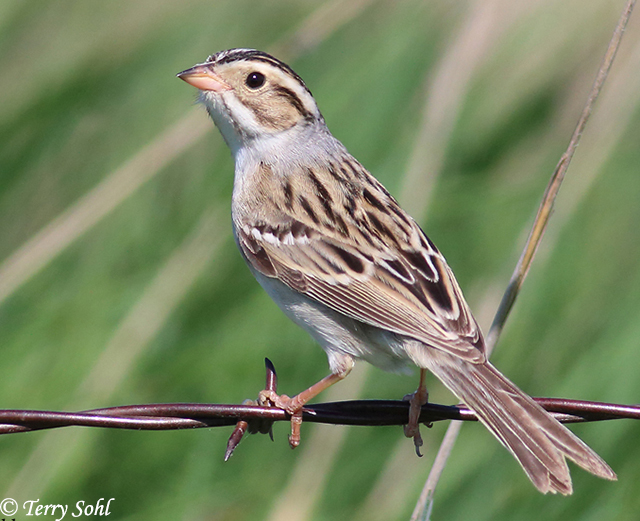
Clay-colored sparrows can be a fairly common sight during the summer in the northern tier of U.S. states. Males are easily observed as they sing their buzzy song from a high perch in their territory. They can sometimes be found in mixed flocks with Chipping Sparrows or Brewer's Sparrows (western South Dakota only for the latter), two species that share a general overall appearance and may be confused with Clay-colored Sparrows, particularly during fall migration when birds are in non-breeding plumage.
Habitat
The Clay-colored Sparrow inhabits shrubby grasslands, mixed-grass prairies, prairie edges, overgrown fields, shelterbelts, brushy pastures, and young shrublands. It is especially associated with grasslands containing scattered shrubs, small trees, or patches of dense vegetation that provide singing perches and nesting cover. In South Dakota, it is a common and widespread breeding bird across prairie habitats throughout much of the state.
Diet
The Clay-colored Sparrow feeds primarily on seeds of grasses, weeds, and other herbaceous plants, especially during fall and winter. During the breeding season it consumes large numbers of insects and spiders, including grasshoppers, beetles, caterpillars, ants, and other small arthropods that are important for both adults and growing nestlings.
Behavior
The Clay-colored Sparrow is a relatively inconspicuous sparrow that spends much of its time foraging on or near the ground in grasslands and shrubby prairie habitats. During the breeding season, males frequently sing from exposed shrubs, fence wires, or small trees while defending territories. It often remains hidden in dense vegetation but may gather in loose flocks during migration and winter, sometimes associating with other sparrow species.
Nesting
June and July in South Dakota. The nest of a Clay-colored sparrow is a relatively large cup (compared to the bird's size), placed close to the ground (usually <4 feet) in a dense bush or clump of weeds. The cup is primarily constructed of grasses, weed stems, and small twigs, lined with finer grasses and very often, animal hair. The female lays between 3 and 6 eggs, with both parents sharing incubation duties. The young hatch from the nest after about 12 days, and fledge from the nest 9 or 10 days after hatching. Parents will continue to protect and feed the young for several days after the young fledge.
Song
Series of three to five identical raspy buzzes, relatively unique compared to most other sparrow species that migrate through the state, or stay for the summer breeding season. The call of a Clay-colored Sparrow is a simple, sharp chip note.
- Click here to hear the buzzy song of a Clay-colored Sparrow1
- Click here to hear the chip calls of a Clay-colored Sparrow2
Migration
The Clay-colored Sparrow breeds across the northern Great Plains and southern Canadian prairies, including much of South Dakota. In fall, it migrates south through the central United States to winter primarily in the southern United States, Mexico, and parts of Central America. During migration it may occur in a variety of brushy habitats, shelterbelts, grasslands, woodland edges, and shrubby fields, often in mixed flocks with other sparrows.
Similar Species
Potentially confused with multiple other sparrow species that can be found in South Dakota.
- Brewer's Sparrow - Brewer's Sparrows have a different normal range than a Clay-colored Sparrow, as they're a bird of the western parts of North America. In South Dakota they are primarily found on the far western edge of the state, but both they and Clay-colored Sparrows could be found in the same locations there. Overall, Brewer's Sparrows are paler in appearance, with less contrast in the plumage patterns than a Clay-colored Sparrow.
- Chipping Sparrow - One of the most common Sparrow species in South Dakota, Chipping Sparrows and Clay-colored Sparrows sometimes may be found in the same locations and can be easily confused. In breeding plumage, the bright rusty-colored cap on a Chipping Sparrow distinguishes it from the Clay-colored Sparrow, who have a streaked cap. In all plumages, Chipping Sparrows have a dark eyeline stripe that is found both in front of and behind the eye, while on a Clay-colored Sparrow the eyeline stripe is only found behind the eye. Overall, Chipping Sparrows also generally appear to be a dingy, very light grayish color underneath, while a Chipping Sparrow generally appears to be more white underneath.
- Field Sparrow - Listed here primarily because both Field Sparrows and Clay-colored Sparrows can be quite common in South Dakota, and are often found in the same habitats. If seen well, Field Sparrows have a much simpler plumage pattern, particularly on the head and face, with a rusty cap and a rusty smudge behind the eye, compared to the multi-colored, strong facial pattern of a Clay-colored Sparrow.
 | 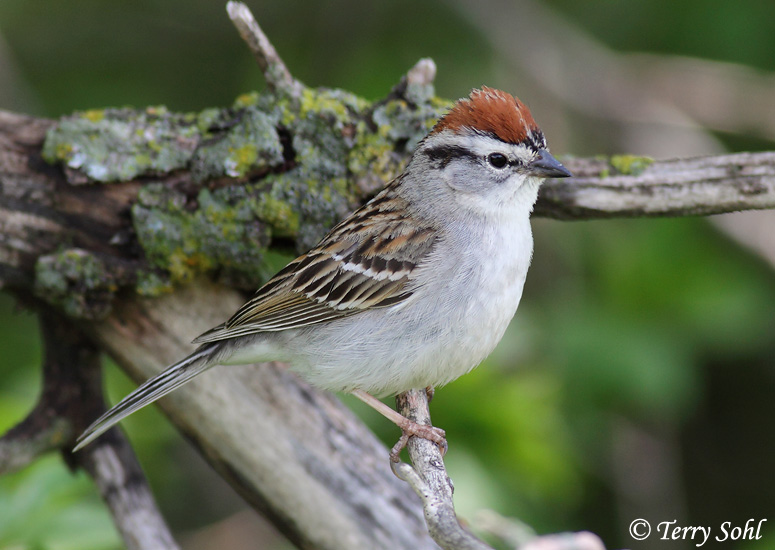 | 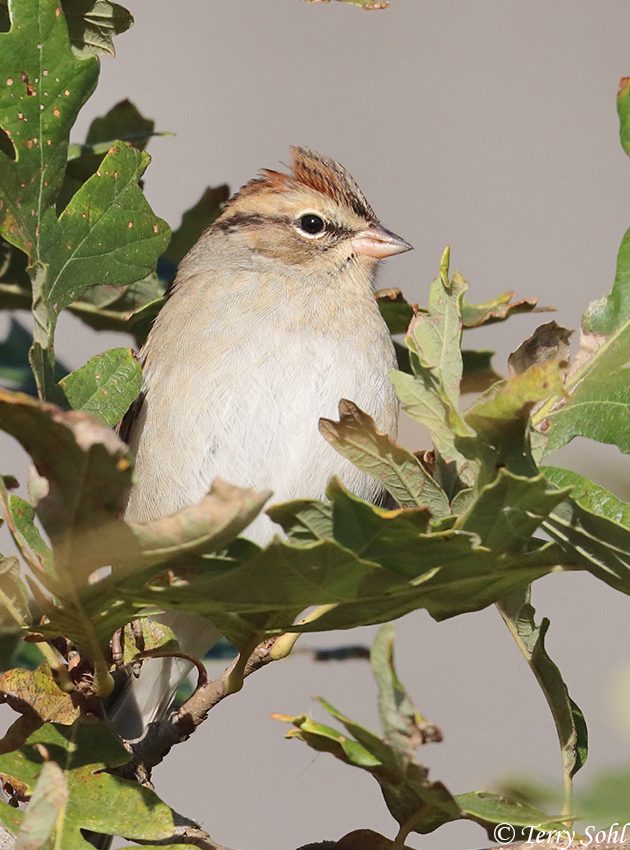 |  |
| Brewer's Sparrow | Chipping Sparrow | Chipping Sparrow | Field Sparrow |
Bird Feeders
Will attend feeders for grains, seeds, and breadcrumbs.
Conservation Status
Surveys hint at a slight decline in recent decades. Reasons are unknown, but they are a fairly common victim of Brown-headed Cowbirdparasitism. However, they are still found across a very broad geographic area and are common in parts of their range. The IUCN considers the Clay-colored Sparrow to be a species of "Least Concern".
Photo Information
May 30th, 2015 - Kingsbury County, South Dakota - Terry Sohl
Audio File Credits
- 1Ian Cruickshank - Recorded in Saskatchewan, Canada on June 21st, 2013. Original recording and information from xeno-canto.
- 2Patrick Turgeon - Recorded in Saskatchewan, Canada on June 10th, 2015. Original recording and information from xeno-canto.
Interactive eBird Map
Click to access the interactive eBird species sightings page for Clay-colored Sparrow
