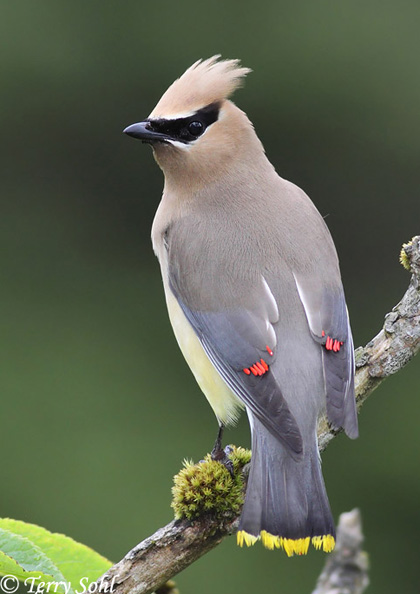
A very nomadic bird, moving irregularly, being present in very large numbers on one occasion and being completely absent on another. Cedar Waxwings are very sociable birds, rarely found alone. They are known for their "fruit passing" behavior, where a line of Waxwings on a branch will sometimes pass a piece of fruit back and forth between birds. The namesake "waxwing", the red waxy tips on the secondary wing feathers, are often a good way to age a Cedar Waxwing, as young birds often show now red at all, while the older the bird, the more red is often present. Cedar Waxwings and Bohemian Waxwings sometimes flock together in the state in the winter, although Cedar Waxwings are typically much more common, especially in the eastern part of the state.
Habitat
The Cedar Waxwing inhabits woodland edges, riparian corridors, orchards, shelterbelts, parks, suburban neighborhoods, old fields, and other areas with abundant fruit-bearing trees and shrubs. It is especially attracted to habitats containing serviceberries, dogwoods, junipers, cherries, crabapples, and other plants that produce berries and small fruits throughout the year.
Diet
Mostly berries and insects. Majority of annual diet is berries and small fruits, especially juniper, dogwood, and wild cherries. Will also eat flower blossoms and catkins. Much of the summer diet includes insects.
Behavior
Extremely social birds, rarely found alone. Cedar Waxwings are often quite tame, allowing close approach by human beings as they forage.
Nesting
Cedar Waxwings have an endearing courtship behavior, with the male bringing a berry or piece of fruit to the female, hopping towards here on a branch and offering it to her. She typically will accept the fruit, hop away a few steps, and return, offering it back to the male. The fruit may be offered back and forth multiple times before the female finally consumes it, signaling to the male that hey, dude...you're pretty cool.
Actual nesting is rather irregular and late compared to most songbirds. The nest of a Cedar Waxwing is a cup placed in the fork of a tree, either deciduous or conifer. The nest is built of grasses, weed stems, rootlets, twigs, and other vegetative material, and often lined with finer grasses or hair. The female lays between 2 and 6 eggs, and both parents help to incubate the young. They hatch after about 12 days, and fledge from the nest about 2 weeks after hatching. If conditions are favorable, Cedar Waxwings may attempt to raise a 2nd brood in a given year.
Song
Vocalizations include a soft, high-pitched, slightly buzzy bzee call, and a high-pitche4d, whistling psee.
- Click here to hear the soft whistled calls of a Cedar Waxwing1
- Click here to hear more soft whistling calls of a Cedar Waxwing2
- Click here to hear the buzzy bzee calls of a Cedar Waxwing3
Migration
The Cedar Waxwing is a somewhat nomadic migrant whose movements are closely tied to the availability of berries and other fruits. It breeds across much of Canada, the northern United States, and higher-elevation forests farther south, then shifts southward during fall and winter, although many birds remain wherever food supplies are abundant.
In South Dakota, Cedar Waxwings are common migrants and summer residents, breeding in woodlands, shelterbelts, riparian areas, towns, and parks throughout much of the state. Large flocks are often seen during spring and fall migration, and some birds may remain through winter, especially in years when fruit crops are plentiful. Because they are highly mobile and food-driven, their numbers can vary considerably from season to season and from one area to another.
Similar Species
Structurally and in plumage Cedar Waxwings are quite unique, with the only typical identification challenge being with it's close relative, the Bohemian Waxwing. Bohemian Waaxwings are much less common in South Dakota, appearing only as winter visitors but the two species are found together at times. Bohemian Waxwings are more common in the western part of the state in winter, and rare visitors in the east.
See the comparison chart for keys to differentiating between the two species.
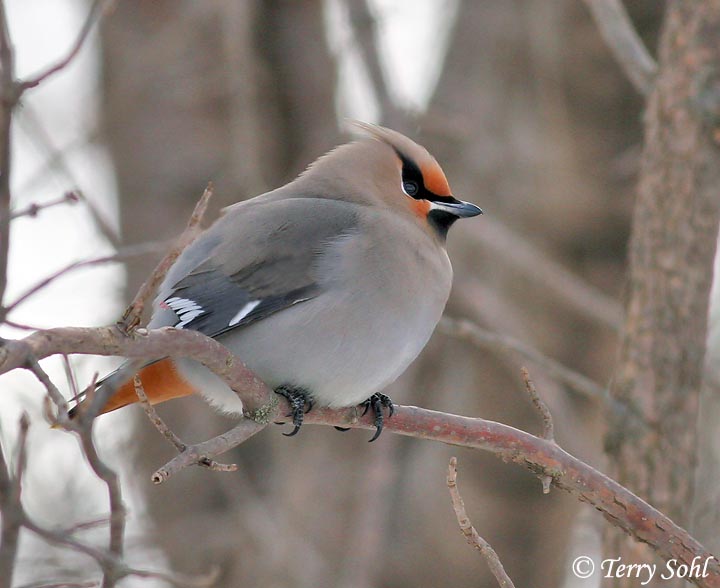 |
| Bohemian Waxwing |
Feeders
Will attend feeders for various fruits and berries. The easiest way to attract them to your yard though is to plant landscaping with the fruits they love. In my yard, I have them come to our sour cherry trees, serviceberry, and arrow-wood viburnum.
Conservation Status
Systematic surveys over the last few decades show substantial increases in populations of Cedar Waxwings. They are found across a very broad geographic area and are common in many parts of that range. The IUCN considers the Cedar Waxwing to be a species of "Least Concern".
Photo Information
June 28th, 2011 - Ecola State Park in Oregon - Terry Sohl
Audio File Credits
- 1Simon Elliott. Recorded in British Columbia on July 31st, 2000. Original recording and information available from xeno-canto.
- 2Manuel Grosselet. Recorded near Mexico City, Mexico on April 15th, 2019. Original recording and information available from xeno-canto.
- 3Phil Brown. Recorded in Essex County, Massachusetts on July 16th, 2018. Original recording and information available from xeno-canto.
Interactive eBird Map
Click to access the interactive eBird species sightings page for Cedar Waxwing
