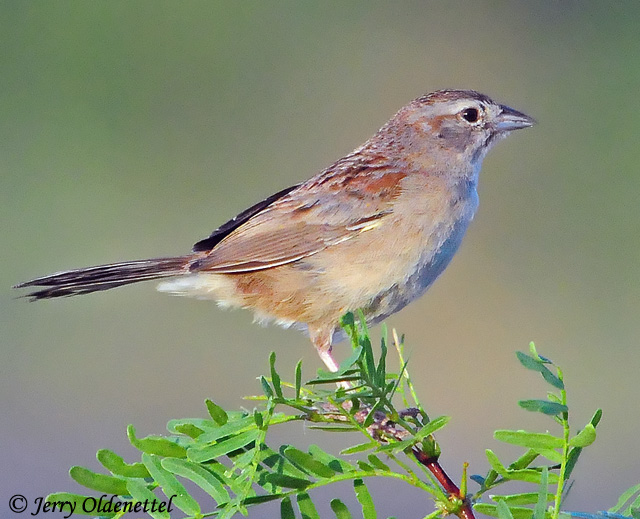
Botteri's Sparrow is a rather plain sparrow of arid areas of Mexico, with a range that just crosses into the U.S. in the far southern tip of Texas and in southeastern Arizona. They have also occasionally been found in southwestern New Mexico. They can be difficult to observe, usually preferring to skulk on the ground or in their preferred grassland habitat in the U.S. They are very similar to the Cassin's Sparrow, and share some of the same habitats. Given the difficult in observing Botteri's Sparrows, they are most often identified by song, which also readily differentiates them from Cassin's Sparrow.
Habitat
The Botteri's Sparrow inhabits dense grasslands, desert grasslands, savannas, shrubby prairies, and brushy fields with tall grasses and scattered shrubs. In the United States it is found primarily in southern Arizona, New Mexico, Texas, and parts of the Gulf Coast region, where it favors relatively undisturbed grasslands with thick ground cover.
Diet
The Botteri's Sparrow feeds primarily on seeds of grasses and other herbaceous plants, especially during fall and winter. During the breeding season it also consumes a variety of insects and other small invertebrates, including grasshoppers, beetles, caterpillars, ants, and spiders, which provide important nutrition for adults and nestlings.
Behavior
The Botteri's Sparrow is a secretive grassland bird that spends much of its time hidden within dense grasses and low shrubs. It usually forages on or near the ground and is often detected by its song rather than by sight. Males frequently sing from grass stems, shrubs, fence posts, or other low perches during the breeding season, especially after summer rains in desert grassland habitats. Forages by walking and hopping along the ground, picking up food items from the ground or gleaning them from low vegetation.
Nesting
The nest of a Botteri's Sparrow is a cup of grasses, built on the ground, usually in the protection of a clump of grass or other vegetation. The female lays 3 or 4 eggs. Both parents help to raise the young after they hatch.
Song
The Botteri's Sparrow gives a distinctive song consisting of a few sharp introductory notes followed by a dry, insect-like buzz or trill, often described as a short explosive zip-zip-zzzzz. Calls include soft chips and ticking notes used for contact and alarm.
Migration
Considered a permanent resident throughout most of its normal range. However, those that breed in the U.S. do typically retreat southward in the winter months.
Interactive eBird Map
Click to access an interactive eBird map of Botteri's Sparrow sightings
Similar Species
In range, most likely to be confused with Cassin's Sparrow , Brewer's Sparrow. To differentiate these three subtle sparrows, focus on their back patterns, bill sizes, and unique vocalizations. The Cassin's Sparrow is identified by a scalloped back pattern and a thinner bill, and it is famous for its "skylarking" flight display and sweet, trilling song. In contrast, the Botteri's Sparrow has a distinctly streaked back, a much larger bill with a thick base, and a song that begins with slow "pips" before accelerating into a dry rattle. The Brewer's Sparrow is the smallest and daintiest of the three, lacks the heavy bill of the others, and is best recognized by its extremely "clean" face with a white eye-ring and a long, complex song of buzzing trills.
Conservation Status
Populations are stable, they are found over a wide geographic area, and they are common in many locations. The IUCN lists the Botteri's Sparrow as a species of "Least Concern".
Further Information
- eBird - Botteri's Sparrow
- Audubon Field Guide - Botteri's Sparrow
- Cornell Lab of Ornithology - All About Birds: Botteri's Sparrow
Photo Information
Photo taken by Jerry Oldenettel - June 26th, 2009 - Hidalgo County, New Mexico - Photo licensed under Creative Commons Attribution NonCommercial ShareAlike 2.0 Generic License.
