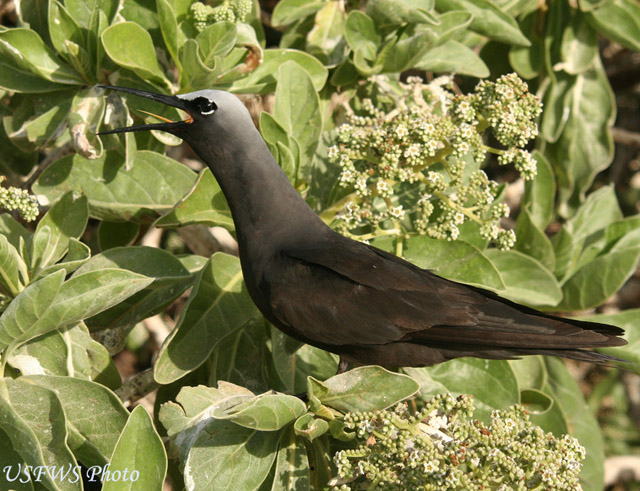
The Black Noddy is a close relative of the Brown Noddy, a bird that nests at the Dry Tortugas off the Florida Keys. However, the Black Noddy is but a rare vagrant in North America, with most sightings consisting of single birds among the Brown Noddies at Dry Tortugas. Elsewhere, they are found in tropical and subtropical areas, with a widespread in the central and western Pacific, including around Hawaii, eastern Australia and New Guinea. More scattered populations occur off the west coast of Africa, southern Asia near India, the east coast of South America, and the eastern Caribbean.
Habitat:
Found around islands in tropical and sub-tropical locations. Even outside of the breeding season, they are typically close to breeding islands or other islands on which they can roost at night.
Diet:
Feeds on fish and small squid, as well as shrimp and krill.
Behavior:
Forages by flying over the water's surface, dipping down to capture prey at or very near the surface.
Nesting:
Colonial nesters, the nest of a Black Noddy is a large shallow cup built of grasses, leaves, sticks, seaweed, and moss, cemented together with excrement. It is usually placed in a small shrub or tree, in a rocky crevice, or on a cliff ledge. The female lays a single egg, and both parents help to incubate it. When the egg hatches, both parents help to feed the youngster. Fledging occurs after about 6 weeks, but the young Noddy is still fed by the parents for several weeks after fledging.
Interactive eBird Map:
Click to access an interactive map of Black Noddy sightings
Song:
The Black Noddy produces a variety of vocalizations, including a rapid, harsh rattle and a sharp "krik-rik-rik" sound often heard in flight. They also communicate with a deep, frog-like croak when on the nest and a quiet, purring note used by males during courtship.
Migration:
Movements of Black Noddies depend upon location. Some birds are likely semi-permanent residents, with foraging and feeding outside of the breeding season still occurring close to breeding sites. In other areas, birds may disperse after breeding, although they typically are found close to islands where they can roost at night.
Similar Species:
Similar in appearance to the Brown Noddy . The Black Noddy does have a darker blackish plumage overall, and is smaller with a noticeably longer and thinner bill.
Conservation Status:
Populations are considered stable, they are found over a wide geographic area, and they are common in some parts of their range. The IUCN lists the Black Noddy as a species of "Least Concern" .
Photo Information:
Photo is public domain photo from U.S. Fish and Wildlife Service.
