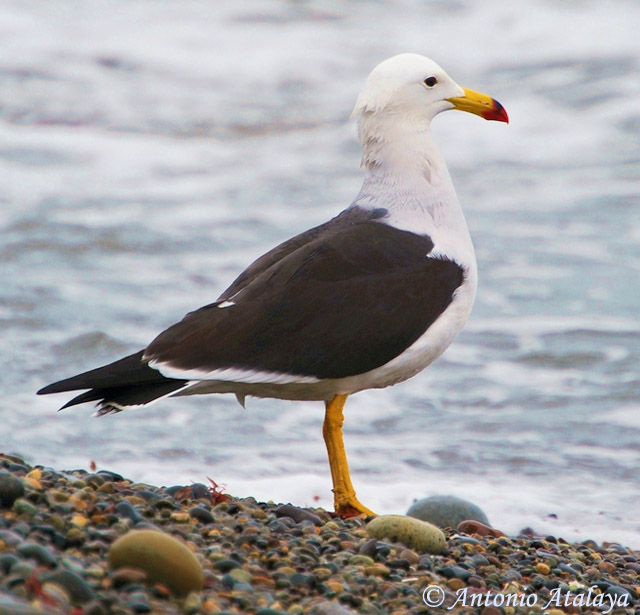
The Belcher's Gull was previously known as the "Band-tailed Gull", along with what is now called the Olrog's Gull, a species found on the Atlantic Coast of South America. The Belcher's Gull is found in Peru and Chile on the Pacific coast of South America. The two species were once called the "Band-tailed Gull" due to the obvious dark band on the end of its white tail. It is named for the British explorer Sir Edward Belcher. In North America, they are known from just a handful of sightings, with one sighting near San Diego in 1987, and a few sightings in Florida. Note that the sightings in Florida of "Band-tailed Gulls" could be Olrog's Gull, given the range of that species on the Atlantic Ocean.
Habitat:
Belcher's gull is typically restricted to the Humboldt Current region along the Pacific coast of South America, primarily in Peru and northern Chile. They inhabit rocky shores, guano islands, sandy beaches, and bays, often foraging a few kilometers offshore and in the intertidal zone.
Diet:
Omnivorous. Food items may include fish, crustaceans, mollusks, eggs, small birds and fledglings, rodents, amphibians, insects, and carrion and refuse.
Behavior:
Uses a variety of foraging techniques, depending upon food item being pursued. They will often walk on the shoreline or in shallow water in search of food. They also will swim on the ocean's surface and grab food. They often will attempt to steal food from other gull and bird species, harassing them until flight until the other bird drops or disgorges their catch.
Nesting:
A colonial nester, nesting on nearshore islands. The nest of Belcher's Gull is a depression on the ground, lined with moss, grasses, leaves, or other vegetative material. The nest is placed in crevices in rocky areas, or on sandy beaches near the high-tide line. The female usually lays 3 eggs, and both parents help to incubate them.
Interactive eBird Map:
Click to access an interactive eBird map of Belcher's Gull sightings
Song:
No information
Migration:
Considered a permanent resident on coastal Peru and Chile, with occasional wandering as far north as Panama.
Similar Species:
Most similar to the Black-tailed Gull or Kelp Gull (like the Belcher's Gull, neither species is normally found in North America). Was once considered the same species as the Olrog's Gull of South America.
Conservation Status:
Populations are small, but they appear to be increasing. The IUCN lists the Belcher's Gull as a species of "Least Concern" .
Photo Information:
Photo taken by Antonio Atalaya - September 6th, 2008 - La Punta, Lima, Peru - Photo licensed under Creative Commons Attribution NonCommercial NoDerivs 2.0 Generic License.
