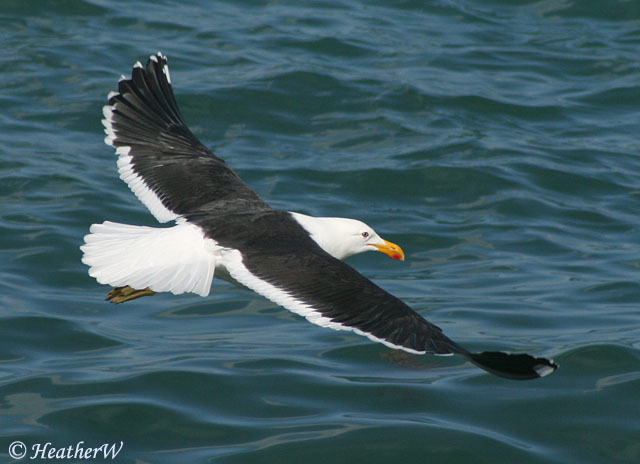
The Kelp Gull has a wide geographic distribution, with populations found in Australia, Africa, and South America. In North America, they are rare visitors, with most records around the Gulf Coast. There have been rare and scattered breeding records north of their normal range, including one from coastal islands off of Louisiana. They are a species that can be difficult to distinguish from some of the more common North American species, such as the Lesser Black-backed and Great Black-backed Gulls, but the Kelp Gull is considered to have the darkest mantle color of all of our gull species.
Habitat
The Kelp Gull inhabits coastal environments of the Southern Hemisphere, including rocky and sandy shorelines, beaches, bays, estuaries, islands, and harbors. It commonly forages along intertidal areas and nearshore waters but also uses inland lakes, rivers, pastures, agricultural areas, and landfills. Breeding colonies are typically located on coastal islands, rocky headlands, beaches, or other open sites near water.Diet
Omnivorous, with food items including fish, crustaceans, mollusks, marine worms, insects, eggs, young birds, small rodents, and carrion and refuse.Behavior
Uses a variety of foraging techniques depending upon location and food item. They will follow fishing vessels and other ships for offal and scraps, and will also visit areas such as garbage dumps for refuse.Nesting
A colonial nester. The nest is built in rocky areas, on sandy shores, or among wetland vegetation, and is a large structure built of seaweed and other vegetation. The female usually lays 2 or 3 eggs, and both parents help to incubate them. Both parents help raise the young after the eggs hatch.Song
Kelp Gulls are loud and highly vocal, producing a variety of harsh calls typical of large gulls. Their most characteristic vocalization is a loud, repeated kee-waw call, often given with the head raised or thrown back during territorial and courtship displays. They also use shorter barking, yelping, and alarm calls during aggressive encounters or when defending nests and young.Migration
Most populations of Kelp Gull are considered to be relatively sedentary, with little consistent migration. However, some birds at the far southern edge of their breeding ranges in the southern Hemisphere may move northward for the winter.Interactive eBird map
Click here to access an interactive eBird map of Kelp Gull sightingsSimilar Species
- Lesser Black-backed Gull -Smaller and more slender than Kelp Gull, with yellow legs, a more delicate bill, and generally longer, narrower wings. Adult Kelp Gulls usually have greenish-yellow to grayish legs and a heavier overall build.
- Yellow-footed Gull - Distinguished by its bright yellow legs and feet, heavy yellow bill, and relatively pale gray-black mantle. It is also geographically distinctive, occurring primarily around the Gulf of California and northwestern Mexico, whereas Kelp Gull is principally a Southern Hemisphere species.
- Great Black-backed Gull - Much larger and bulkier, with an exceptionally heavy bill, broad wings, and pink legs. Its mantle is typically very dark blackish-gray, and its massive size is usually the easiest field mark when directly compared with Kelp Gull.
